
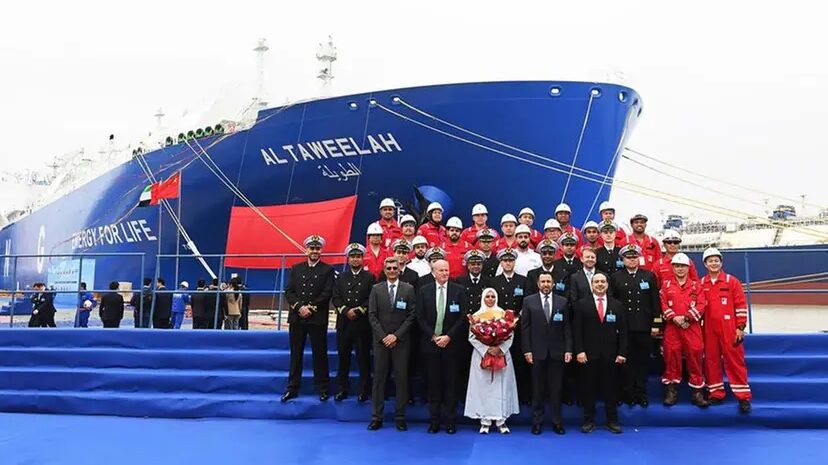
ADNOC Logistics & Services has taken delivery of its sixth new-build LNG carrier with a capacity of 175,000 cubic metres from Jiangnan Shipyard in China. Moreover, the delivery further expands the company’s shipping platform as global energy supply chains continue to face pressure.
The vessel forms part of a $1.2 billion LNG fleet order placed in 2022. Additionally, the programme supports fleet modernisation and capacity growth to meet rising global demand more efficiently.
Long-term contracts underpin earnings visibility
Captain Abdulkareem Al Masabi, CEO of ADNOC L&S, said, “Each new carrier strengthens our ability to reliably deliver energy and essential commodities across international routes, particularly at a time when supply chains are under pressure. We continue to expand our fleet capacity in close alignment with customer demand, seizing commercial opportunities while securing long-term earnings visibility. For our investors this translates into sustainable value creation and shareholder returns.”
A single 175,000 cubic metre LNG shipment carries around 1.1 terawatt-hours of energy. As a result, it can cover typical winter gas demand for roughly 100,000 households in Central Europe.
The company has committed most of the additional LNG capacity under long-term contracts with third-party customers and group entities. Furthermore, around 60% of revenue from ADNOC L&S and its AW Shipping joint venture is secured through long-term agreements.
Fleet expansion supports efficiency and emissions goals
The vessel, named “Al Taweelah”, was delivered during a ceremony held at Jiangnan Shipyard in Shanghai. Additionally, the ship includes advanced energy-efficiency technologies designed to cut methane emissions by up to 50% compared with older-generation vessels.
The company continues to expand its fleet pipeline. Moreover, vessels under construction include seven Very Large Ethane Carriers and four Very Large Ammonia Carriers under a $1.9 billion AW Shipping order placed in 2024.
In the same year, ADNOC L&S also ordered eight LNG carriers worth about $2.5 billion from Samsung Heavy Industries and Hanwha Ocean. Therefore, the company is reinforcing its longer-term growth strategy in global energy transport.
