
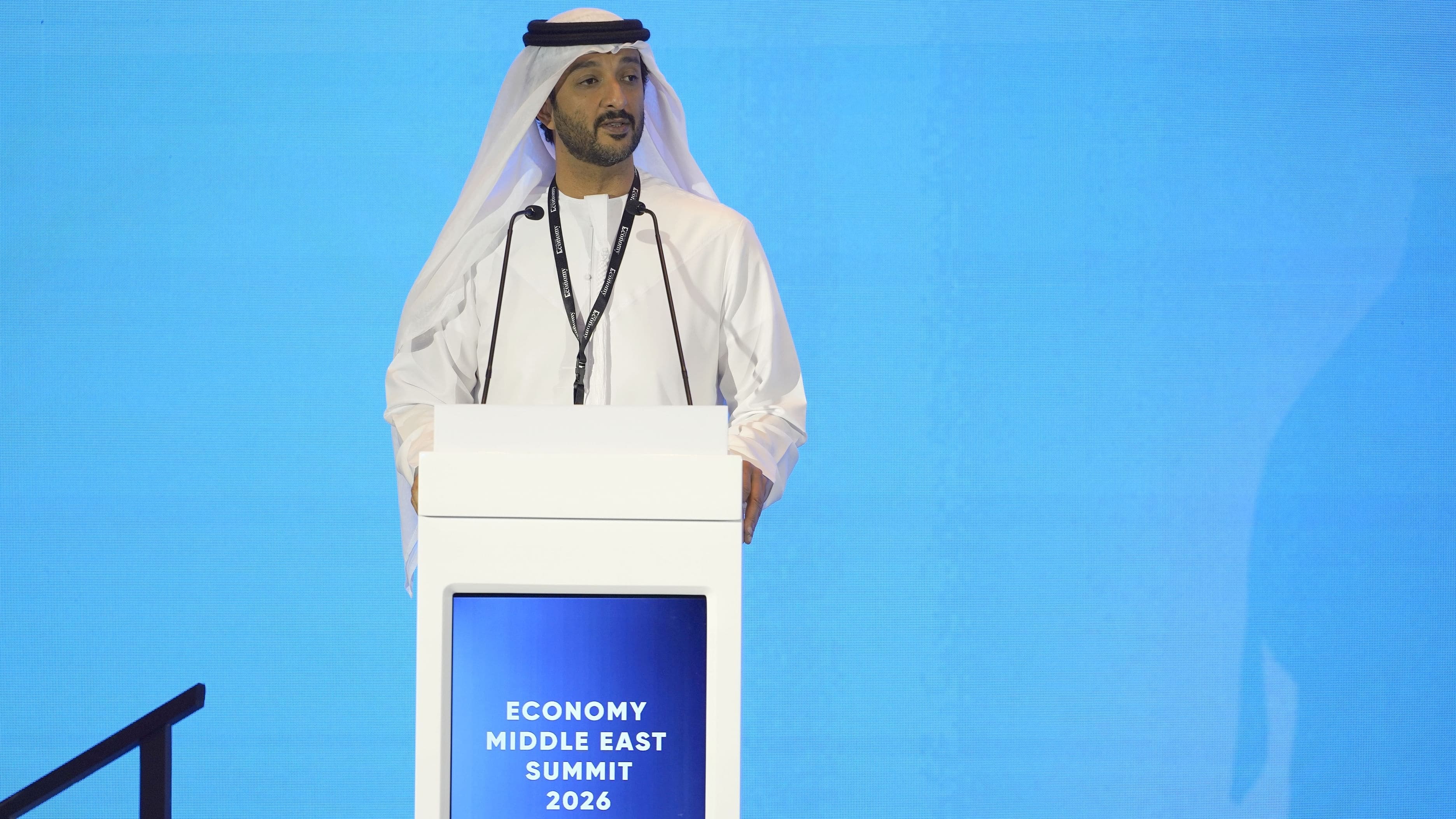
Abdulla bin Touq Al Marri said the UAE continues to strengthen an economic model built on openness, adaptability, and long-term resilience despite ongoing geopolitical instability and regional challenges. Speaking during Economy Middle East Summit 2026, the minister highlighted the country’s sustained economic performance and expanding non-oil sectors as indicators of structural diversification.
According to Al Marri, the UAE designed its economy to remain operational during periods of uncertainty rather than relying solely on conditions of global prosperity. Consequently, the country continues to position itself as a stable and predictable economic environment for international investors, businesses, and trade partners.
“Abdulla bin Touq Al Marri, Minister of Economy and Tourism, said that the UAE continues to consolidate an economic model based on openness, continuity and adaptability to global changes, noting that the national economy has demonstrated its ability to maintain competitiveness and stability despite geopolitical challenges and regional fluctuations.”
The minister also emphasised the growing importance of economic reliability in an increasingly fragmented global landscape. Therefore, he argued that economies capable of maintaining operational efficiency and continuity under pressure will gain long-term competitive advantages.
Non-Oil Economy Drives UAE Growth and Trade Expansion
During the summit, Al Marri pointed to several indicators reflecting the UAE’s economic transformation over recent years. He stated that average annual GDP growth between 2021 and 2025 reached approximately 5%, while non-oil sectors expanded by around 6.2% during the same period.
“He noted that the country’s average annual GDP growth between 2021 and 2025 reached around 5%, while non-oil growth stood at approximately 6.2 %.”
The minister further explained that non-oil industries now contribute more than 77% of the UAE’s GDP. Meanwhile, non-oil foreign trade surpassed AED3.8 trillion in 2025, marking a record level for the country’s expanding trade network. In addition, non-oil exports reached AED813 billion, reinforcing the UAE’s position as a regional logistics, finance, and trade hub.
“He added that non-oil activities now account for more than 77 % of the UAE’s GDP, while the country’s non-oil foreign trade exceeded AED3.8 trillion in 2025. Non-oil exports reached AED813 billion, both representing record levels.”
These figures reflect the UAE’s ongoing diversification strategy across technology, tourism, renewable energy, manufacturing, and financial services. As a result, the economy increasingly depends less on hydrocarbons and more on globally connected commercial sectors.
UAE Positions Itself as a Stable and Predictable Economic Hub
Al Marri also addressed the broader geopolitical environment shaping regional economies. He noted that the Middle East continues to experience heightened instability following some of the region’s most serious conflicts in decades. However, he argued that the UAE’s institutional stability and economic continuity remain central to maintaining investor confidence.
“He added that the region is going through an exceptional phase that has witnessed one of the most serious conflicts in decades, explaining that the first test under such circumstances is security, the second is continuity, and the third is trust.”
The minister stressed that the UAE’s core economic message focuses on operational consistency, openness, and predictability. Furthermore, he stated that the country’s diversification agenda has evolved beyond strategic ambition into measurable structural transformation.
“He said these indicators confirm that economic diversification in the UAE is no longer merely an ambition, but has become clearly reflected in the structure of the national economy.”
The remarks reinforce the UAE’s broader positioning as a global business and investment centre capable of navigating economic volatility while continuing to attract international capital and trade partnerships.
