
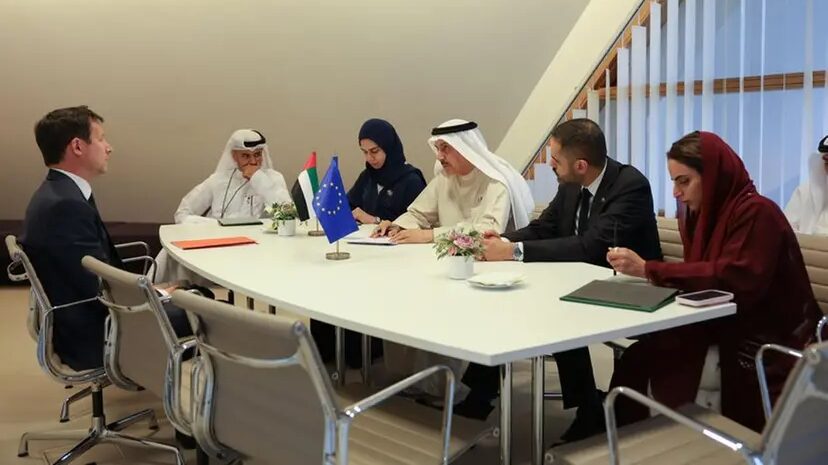
UAE Minister for Foreign Trade Dr. Thani bin Ahmed Al Zeyoudi outlined the country’s trade resilience strategy and broader economic response to global supply chain disruptions during a panel at the GLOBSEC Forum 2026 in Prague, where he emphasised the UAE’s position as a stable and adaptive global trade hub.
Addressing policymakers and international business leaders, Al Zeyoudi said the UAE has implemented both immediate and structural measures since the onset of the conflict, which has affected key global trade routes. Moreover, these measures are designed to maintain continuity of trade flows while reinforcing long-term supply chain resilience.
Trade corridors and logistics diversification
The UAE has activated multiple alternative trade routes to mitigate disruption. These include the use of eastern ports such as Fujairah and Khorfakkan. Additionally, air freight bridges have been deployed for time-sensitive shipments of pharmaceuticals and food.
Furthermore, a Green Corridor with Oman has been established to streamline cross-border logistics. A Sharjah–Dammam trade bridge has also been introduced to strengthen regional connectivity. As a result, the UAE has expanded its logistical flexibility across maritime, air and land networks.
Al Zeyoudi also highlighted financial and operational support measures. The government deployed an AED 1 billion economic support fund to sustain business continuity and provide targeted relief for small and medium-sized enterprises. Moreover, the Central Bank introduced a five-pillar financial institution resilience package to ensure continued credit availability across the economy.
“The fundamental redesign of Gulf logistics that we were undertaking over a decade is now being compressed into years,” said Al Zeyoudi. “What this moment has done is accelerate the timelines of existing plans, and underscore the wisdom of building an open, diversified, and resilient trade architecture before it is needed.”
Long-term trade strategy and CEPA expansion
Al Zeyoudi also reaffirmed the UAE’s long-term trade strategy through its Comprehensive Economic Partnership Agreement (CEPA) programme. This framework has resulted in 36 agreements across six continents and contributed to US$1.03 trillion in non-oil foreign trade in 2025.
Moreover, he emphasised that the CEPA network remains a central pillar of the UAE’s trade expansion strategy. Therefore, it strengthens access to high-growth markets across the Gulf, Africa and Asia.
“Nothing that we have achieved in the last five years has been undone or unwound,” he said. “The UAE is a bridge to high-growth markets across the Gulf, Africa and Asia, and a partner for trade, logistics, investment and technology. That role has not diminished. It has become more important.”
