
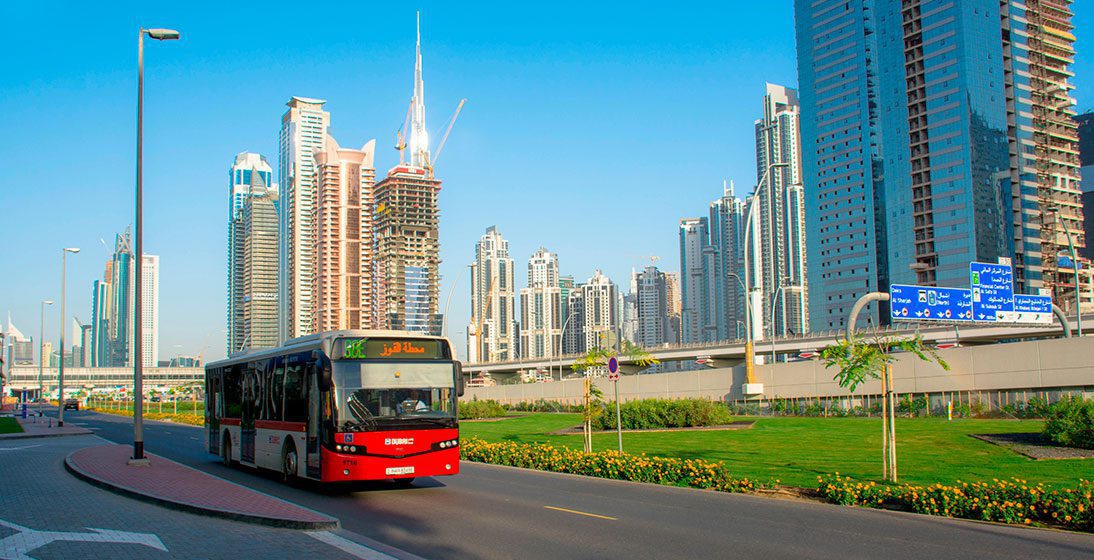
The Roads and Transport Authority (RTA) in Dubai has announced its ambitious plan to achieve a zero-emission public transport system by the year 2050. This initiative, called the Zero-Emissions Public Transportation in Dubai 2050 strategy, aims to significantly reduce carbon dioxide emissions by 10 million tonnes. Additionally, the plan is projected to save AED 3.3B (equivalent to $817M) compared to current operational costs.
The strategy encompasses various measures, including the introduction of electric taxis, the construction of net-zero buildings, and the implementation of sustainable waste management services. By adopting these sustainable practices, Dubai’s public transport system aims to become a pioneer in the Middle East, taking the lead in transitioning towards net-zero emission transportation.
The RTA’s long-term strategy aligns with the UAE’s preparations for COP28 (the 28th United Nations Climate Change Conference) and the UAE Net Zero by 2050 Strategic Initiative. It reflects the RTA’s commitment to advancing sustainability in roads and transportation, as well as its ambition to achieve global leadership in sustainable mobility. Dubai’s Roads and Transport Authority (RTA) is working towards enhancing the adaptability of public transport infrastructure and its contribution to combating climate change, in accordance with the UAE Net Zero by 2050 Strategic Initiative. The aim is to transform commitments into tangible accomplishments, according to Arabian Business.
In line with the Dubai Economic Agenda D33, which aims to solidify the emirate’s position as a leading global urban economy, the RTA has developed a new strategy with multiple objectives for the coming years.
The key goals include the decarbonization of taxis, limousines, and public buses, the construction of energy-efficient buildings with minimal energy consumption, the utilization of renewable energy sources, and the elimination of municipal waste by diverting it away from landfills.
By pursuing these objectives, Dubai’s public transport system aims to play a significant role in reducing carbon emissions, promoting sustainability, and achieving environmental targets. The strategy reflects the commitment of the RTA and Dubai to prioritize flexibility, climate impact, and tangible achievements in the realm of transportation infrastructure.
Mattar Al Tayer, Director-General and Chairman of the Board of Executive Directors, RTA, said: “The new strategy outlines a comprehensive approach to sustainability within RTA. Its primary objective is to enhance sustainability and reduce carbon dioxide emissions.”
“At the same time, it contributes to realising RTA’s mission of achieving global leadership in smooth and sustainable mobility through innovative roads and transport services that elevate the customer experience to world-class standards.”
“The new strategy encompasses ten initiatives, covering various RTA sectors and agencies, in addition to partnerships with the private sector that contribute to implementing the strategy over five years.”
“The strategy will review, adjust and align future goals with changing circumstances.”
As part of the comprehensive strategy to achieve net-zero emissions by 2050, Dubai’s Roads and Transport Authority (RTA) has outlined specific targets in three key categories: green public transportation, buildings and facilities, and waste management. In terms of public transportation, the plan focuses on the conversion of buses into electric and hydrogen-powered vehicles. The goal is to convert 10% of public transport buses to these clean energy alternatives by 2030, with the percentage increasing to 20% by 2035, 40% by 2040, 80% by 2045, and ultimately reaching 100% by 2050.
Similarly, the strategy aims to transition the taxi and limousine fleet towards electric and hydrogen vehicles. The plan is to convert 30% of taxis and limousines to these environmentally friendly options by 2030, increasing the percentage to 50% by 2035, and achieving complete electrification by 2040.
Furthermore, the zero-emission strategy addresses the conversion of Dubai Transport Corporation’s (DTC) school buses. The objective is to convert 10% of school buses into electric and hydrogen-powered vehicles by 2030, with the percentage rising to 30% by 2035, 50% by 2040, 80% by 2045, and reaching 100% by 2050.
These ambitious targets demonstrate Dubai’s commitment to transitioning its public transportation system towards sustainable and zero-emission alternatives, contributing to a greener and more environmentally conscious future.
As part of Dubai’s comprehensive strategy for sustainability, the Roads and Transport Authority (RTA) has outlined plans to retrofit its buildings and facilities with solar cell systems. By 2025, 24 buildings and facilities will have solar panels installed, and feasibility studies will determine the expansion of this initiative to all other structures. The goal is to retrofit and upgrade 74% of buildings by 2030, increasing it to 83% by 2035, and ultimately achieving 100% by 2045. Additionally, new buildings constructed from 2025 onward will aim for near-zero energy consumption.
The RTA also plans to retrofit existing streetlights to ensure 100% energy efficiency, while implementing waste management programs to achieve 100% reuse and recycling of municipal waste by 2030. The objective is to eliminate municipal waste going to landfills entirely. Furthermore, the strategy aims to increase the usage of recycled water in RTA’s buildings and facilities to 40% by 2050.
The RTA has already achieved remarkable sustainability accomplishments. From 2014 to 2022, their energy and green economy initiatives resulted in significant electricity and water savings, equivalent to approximately 360 gigawatt-hours and 300 million gallons, respectively. Moreover, they saved around 88 million liters of gasoline and 10 million liters of diesel, avoiding approximately 416,000 tons of equivalent emissions and yielding savings of approximately AED 420M.
Notably, the RTA has set high standards for transparency and accountability. They were the world’s first roads and public transportation entity to release a sustainability report adhering to the Global Reporting Initiative (GRI) standards and the international standard: ISAE3000 in 2018. Furthermore, in 2020, the authority signed the United Nations Global Charter for Sustainable Development, aligning their sustainability reports with the UN’s goals addressing global challenges.
Dubai’s RTA is making significant strides in sustainable development and aims to become a global leader in promoting eco-friendly transportation and infrastructure while actively contributing to the United Nations’ sustainable development goals.
