
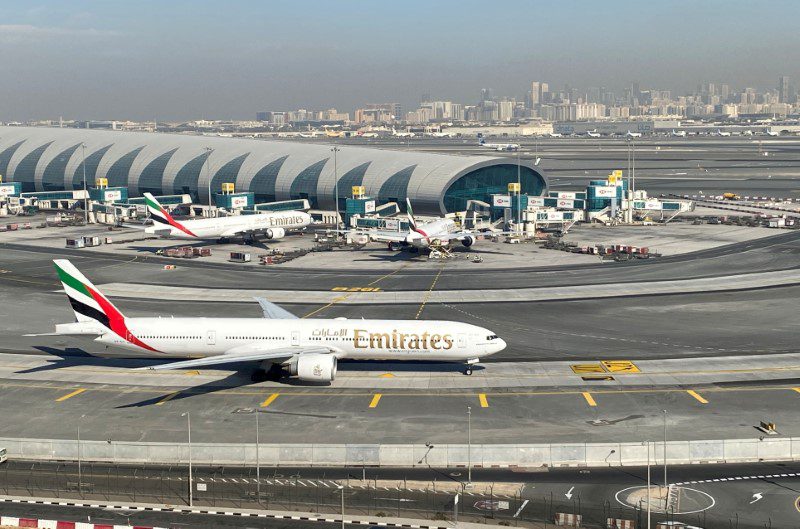
World’s busiest hub raises annual passenger forecast for 2022 to 62.4 million from the previous forecast of 58.3 million.
Passenger traffic at Dubai International Airport (DXB) nearly tripled in the second quarter despite reduced capacity after one of its two runways was closed for 45 days of renovations.
The world’s busiest international airport handled 14.2 million passengers, up about 191 percent year-on-year during the three-month period to the end of June, maintaining growth for nine consecutive quarters since the start of the coronavirus pandemic, state-owned operator Dubai Airports said on Wednesday.
“Not only has Dubai Airports been successful in managing the recovery, but customer service quality has been maintained throughout,” Paul Griffiths, chief executive of Dubai Airports, said.
“We knew at the start of the pandemic that the dramatic downturn would be followed by an equally dramatic upturn, so we were well prepared for it and using all of the business data at our disposal were able to predict the start of the recovery. We worked with our service partners across the airport community to be ready.”
The recovery at the airport, the hub of long-haul airline Emirates, comes during a strong rally in international travel. In June, international traffic rose about 230 per cent year-on-year, helped by the lifting of travel restrictions in most parts of Asia-Pacific, according to the latest data from the International Air Transport Association (Iata).
Passenger volumes in the first half of the year more than doubled to 27.9 million, compared with the same period last year, Dubai Airports said. This is 1.2 million short of the airport’s total annual traffic last year.
The airport has reached 67.5 per cent its pre-pandemic passenger traffic in the first half of 2019.
“DXB’s recovery from the impact of the global pandemic has been spectacular, and that position has been strengthened during 2022, particularly during the second quarter,” Mr Griffiths said.
Dubai hosted 7.12 million international visitors in the first half of 2022, nearly three times the 2.52 million recorded in the same period last year, despite the impact of “unprecedented challenges” and “macroeconomic factors” affecting the global economy and tourism sector, Dubai’s Department of Economy and Tourism (DET) said this month.
Dubai Airports now expects 62.4 million passengers in 2022, raising its annual traffic forecast from an earlier projection in May of 58.3 million.
India remained DXB’s top source country by passenger numbers, with traffic for the first half of the year reaching 4 million passengers — driven mainly by top city destinations such as Mumbai, Delhi and Hyderabad.
Saudi Arabia followed with 2 million passengers, with the UK with 1.9 million passengers.
The top three cities were London with 1.3 million passengers, Riyadh with 910,000 passengers, and Mumbai with 726,000 passengers.
Amid disruption, long queues and delayed baggage at major airports in Europe and the US, DXB said that 96 per cent of passengers queued for fewer than five minutes at the departure passport control.
The average queuing times at security check on departure was less than three minutes for 97 per cent of total passengers.
In terms of the air freight business, cargo volumes for the first six months of the year fell nearly 19 per cent year-on-year to 910,075 tonnes.
DXB’s cargo traffic was hit during the second quarter, as major freight operators shifted back to Dubai World Central (DWC) in March, Dubai Airports said.
In addition, due to the reduction in cargo traffic during the North Runway Refurbishment Program from 9 May to 22 June, a significant portion of DXB cargo traffic was carried in the hold of passenger aircraft, resulting in a reduction in total traffic.
