
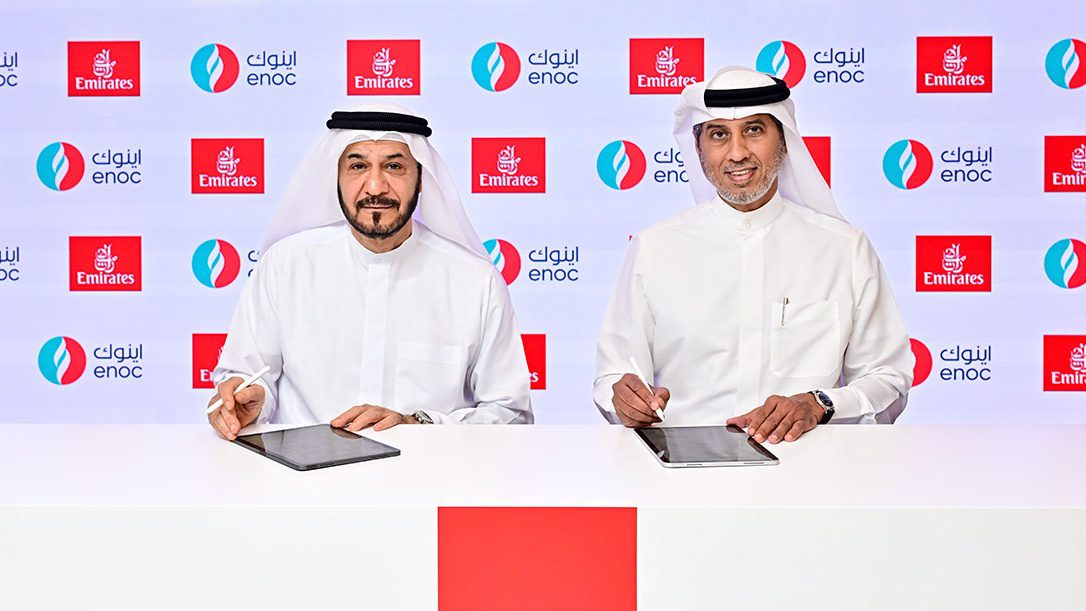
ENOC Group has signed an agreement with Emirates to explore new pathways for Sustainable Aviation Fuel supply at the airline’s Dubai hub. Since the partnership focuses on long-term sustainability goals, both parties will examine how SAF can be integrated more effectively into future operations. The MoU, signed during the Dubai Airshow, sets the groundwork for feasibility studies that will evaluate supply chain infrastructure, production options, and commercial practicality.
Why SAF Matters for Future Aviation
Sustainable Aviation Fuel, already certified as a safe drop-in alternative, can blend with conventional jet fuel at up to 50 percent. Because of its significantly lower lifecycle emissions, it remains a central focus for global decarbonisation efforts. In its neat form, SAF can cut lifecycle emissions by as much as 80 percent. This impact keeps it at the forefront of aviation-sector climate strategies. Commenting on the partnership, Adel Al Redha said, “Emirates continues to explore ways to integrate sustainable aviation fuel adoption in our operations, and this partnership with ENOC represents an important step in that journey.” He added that establishing reliable supply in Dubai is a priority, and he noted the challenges involving infrastructure and availability.
Hussain Sultan Lootah highlighted the sector-wide importance of the transition, stating, “At ENOC, we recognise the critical role that Sustainable Aviation Fuel plays in reducing carbon emissions across the aviation sector.” He also emphasised that the collaboration aligns with national goals to supply locally produced SAF to airlines by 2031.
Ongoing Progress in the UAE’s SAF Ecosystem
Emirates continues to support SAF development through participation in national technical groups and committees focused on new fuel pathways. Additionally, the airline has conducted several demonstration flights, including a Boeing 777 flight in January 2023 that used 100 percent SAF in one engine, as well as an A380 demonstration flight in November 2023 under similar conditions. That same month, it operated flights from Dubai International Airport using blended SAF integrated directly into the airport’s fueling system. During the 2024–25 financial year, the airline procured 7,519 tonnes of SAF at multiple airports, reinforcing its commitment to scaling adoption across its network.
