
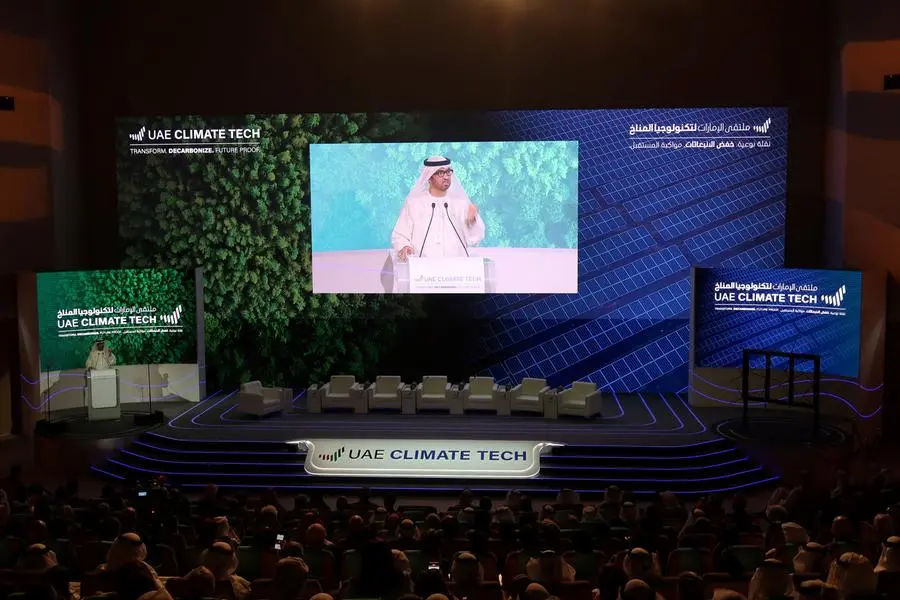
The UAE Ministry of Industry and Advanced Technology (MoIAT) organized three sessions during the UAE Climate Tech forum to encourage innovation and entrepreneurship in the areas of green technology and climate action.
These sessions were aimed at contributing to the country’s climate neutrality targets ahead of COP28 and focused on the UAE’s investment, innovation, technology, and entrepreneurship ecosystem, which is a crucial pillar of COP28. The UAE Climate Tech forum took place in preparation for COP28, which will be held in November at Expo Dubai, according to WAM.
Sarah Al Amiri, Minister of State for Public Education and Advanced Technology, said: “In line with the objectives of the National Strategy for Industry and Advanced Technology, the Ministry of Industry and Advanced Technology is developing an industrial sector that is underpinned by advanced technology, research and development, and sustainability. This foundation contributes to the UAE’s climate neutrality targets as well as to national efforts to achieve sustainable economic and industrial development.”
The speaker emphasised that the UAE has taken a practical and realistic approach towards decarbonization, implementing measures across all stages of the value chain. The country has created an environment that facilitates climate action through policies, financing, technology, and partnerships.
The minister added: “Promoting entrepreneurship, research and innovation in the industrial sector, especially in climate technology, is among the ministry’s key priorities in driving in climate action. The UAE Climate Tech forum is a key platform that brings together the relevant ecosystem players to accelerate game-changing climate tech solutions. The forum is in line with the UAE’s preparations to host COP28 and showcases national efforts to transform into a global hub for sustainable industries and advanced technology.”
At the UAE Climate Tech forum, MoIAT urged entrepreneurs, innovators, and startups to participate in COP28 and explore investment opportunities in financing climate action. The ministry highlighted successful entrepreneurial stories in the green technology field and showcased the UAE’s supportive ecosystem and opportunities for startups.
The sessions also emphasized incentives and enablers that promote technology company growth and support for entrepreneurs and investors. One session, in partnership with the COP28 team, explored the conference’s Technology and Entrepreneurship Program and its role in promoting innovation and technology for a climate-neutral world.
The session focused on showcasing technologies, facilitating partnerships, and promoting innovation as a pathway to a sustainable economy. Additionally, the session provided an overview of partnership opportunities at COP28, including priorities for a successful energy transition and technological progress to decarbonize at scale and deliver climate action across the value chain. Participants also emphasized the importance of partnerships and international cooperation in accelerating technological change.
The Ministry of Industry and Advanced Technology (MoIAT) hosted two roundtables titled ‘Climate Technology Exchange’ at the UAE Climate Tech forum. The roundtables included representatives from climate technology startups and various entities such as Emirates Development Bank, ADNOC, Dubai Electricity and Water Authority, Catalyst, Strata, IBM, and Masdar.
The discussions highlighted the UAE’s supportive ecosystem for climate technology startups, including incubation programs, financing, pilots, and partnerships. The sessions also emphasized the role of the government and private sector in promoting the adoption of climate technologies to achieve the country’s sustainability targets.
In addition, MoIAT led a third session in partnership with the United Nations Industrial Development Organisation (UNIDO) on boosting private sector partnerships for climate action efforts and showcasing the impact of the industrial sector in providing innovative technological solutions for the energy transition and decarbonization.
The session was attended by representatives from MoIAT, UNIDO, Siemens, and Schneider Electric. The discussions touched upon decarbonizing heavy and hard-to-abate industries such as cement, iron, and petrochemicals, and the importance of advanced technologies, financing, and policies in growing demand for low-carbon energies and boosting strategic partnerships across markets.
