
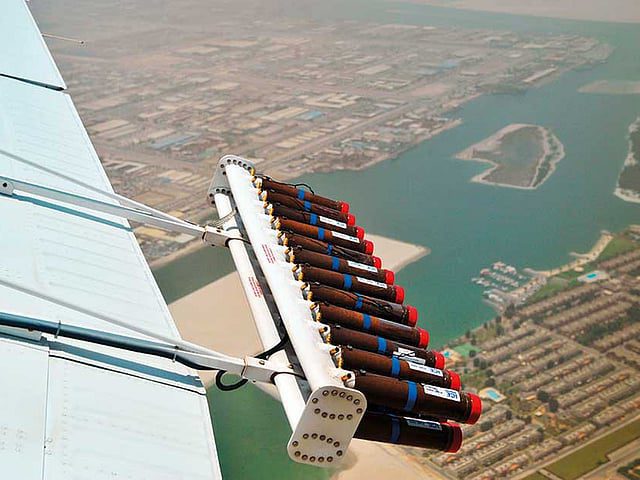
In Dubai, the National Center of Meteorology in Abu Dhabi unveiled the recipients of the latest cycle of the UAE Research Programme for Rain Enhancement Science, awarding three research teams grants of up to $1.5 million (Dh 5.511 million) each over three years, as part of the UAE’s commitment to addressing water scarcity with scientific innovation.
The funded projects represent three distinct strategies to enhance rainfall. Dr Dixon Michael from Colorado plans to combine artificial intelligence with dual‑polarisation radar to analyse cloud behaviour during seeding, aiming to move from assumptions to data‑driven insights on the effectiveness of different seeding techniques.
Professor Linda Zou of Australia is working on innovative nanotechnology‑based cloud seeding agents designed to generate ice crystals more efficiently than existing substances. Her team will employ AI to refine these particles and set up specialised testing tools at the meteorology centre, where UAE scientists will also receive training.
Dr Oliver Branch from Germany is pursuing the most novel approach, exploring whether altering the landscape and land cover in targeted areas can naturally generate conditions favourable for rainfall, potentially offering a longer‑term alternative to temporary cloud seeding methods.
Dr Abdulla Al Mandous — director general of the National Center of Meteorology and president of the World Meteorological Organization — highlighted that the programme reflects the UAE’s commitment to funding science with substantial resources, granting winners access to advanced facilities and technical support that are otherwise difficult to obtain.
The selection process was highly competitive: when the programme opened for applications in January 2025, 140 teams applied, 16 advanced to the full proposal stage, and just three were chosen for funding. Winners will receive up to $550,000 per year to support their multi‑year research endeavours.
Alya Al Mazrouei, director of the rain enhancement programme, noted that the benefits extend beyond funding: awardees are integrated into international scientific networks, gain access to extensive UAE research datasets, and receive practical support to translate their theoretical work into real‑world solutions for water security.
