
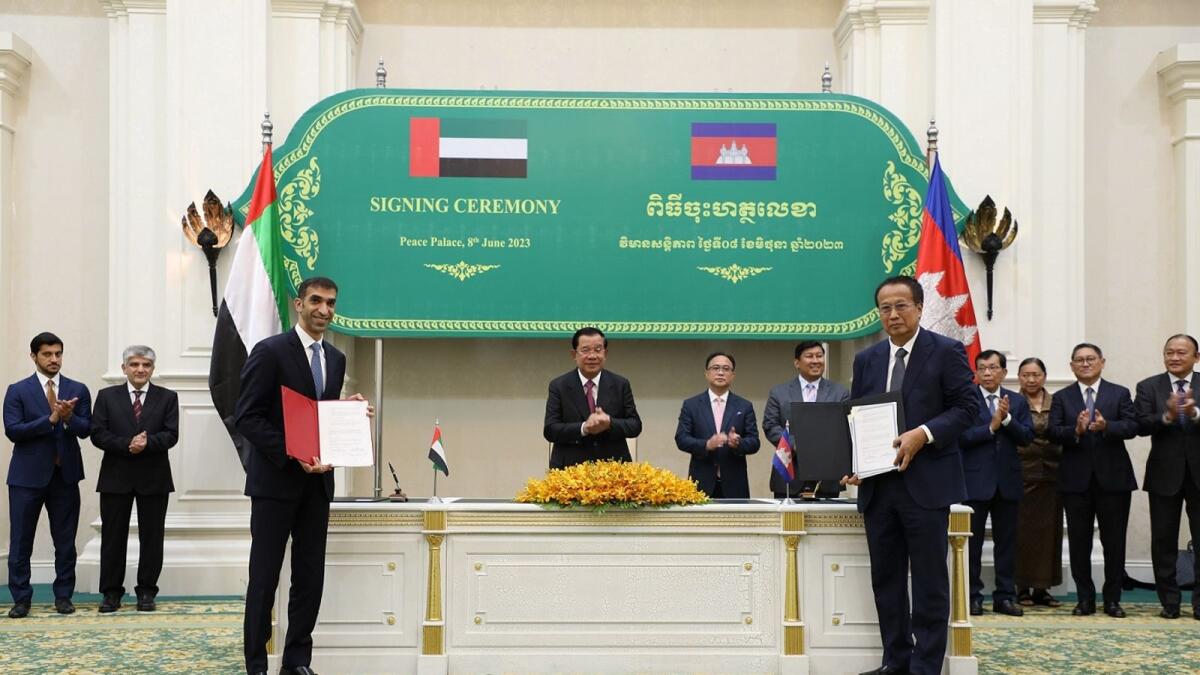
UAE and Cambodia have recently signed a Comprehensive Economic Partnership Agreement with the goal of significantly increasing their non-oil bilateral trade in the next five years. According to the UAE Ministry of Economy, the agreement seeks to elevate trade from its current value of $407M in 2022 to a staggering $1B, according to The National News.
The signing ceremony took place in Phnom Penh, where H.E. Dr Thani Al Zeyoudi, the UAE Minister of State for Foreign Trade, and Pan Sorasak, Cambodia’s Minister of Commerce, formally endorsed the pact in the presence of Cambodia’s Prime Minister, Hun Sen.
Key Objectives of the Agreement
The negotiations for the Comprehensive Economic Partnership Agreement were successfully concluded in April, paving the way for this mutually beneficial economic collaboration. The agreement aims to eliminate or reduce customs duties, remove trade barriers, facilitate investments, expand market access for service exports, and create more opportunities for business partnerships.
The UAE-Cambodia Cepa is a “new milestone in our foreign trade agenda that strengthens our growing role in the east-west trade corridor”, said Dr Al Zeyoudi.
“It will not only contribute to our goal of doubling non-oil foreign trade by 2031 but also expand our presence in the rapidly growing economies of South-East Asia, opening new doors for exporters to reach millions of consumers.”
“Cambodia will also benefit from our global connectivity and ability to re-export goods to more than 400 cities around the world. We will continue to expand global trade to foster long-term, sustainable growth and economic diversification with all whom we do business with.”
UAE’s Trade Strategy and Global Position
The UAE is actively pursuing 26 Comprehensive Economic Partnership Agreements (Cepas) as part of its strategy to strengthen trade and economic relations worldwide and attract more investment to diversify its economy.
Trade between the UAE and Cambodia has been growing steadily, reaching $407M in 2022, a 33% increase compared to 2021 and a significant 28% rise from 2019. As Cambodia’s top trading partner in the Arab world, the UAE accounted for 70% of its trade with the region in 2022. The economic pact with Cambodia opens up a range of investment opportunities in sectors like tourism, logistics, infrastructure, and renewable energy.
The agreement ensures UAE businesses access to various service sectors in the Cambodian market while guaranteeing market access for Emirati products, covering a significant portion of customs tariff lines and non-oil trade value. Both countries will now undergo the necessary procedures for the ratification of the Cepa, with the deal expected to come into force before the end of this year. With a focus on developing new trade corridors and diversifying its exports, the UAE aims to boost its exports to reach AED 2T ($545B) by 2030, growing faster than the global average. The projections indicate growth in sectors like metals and minerals, accounting for 73% of exports by 2030, and plastics and rubbers.
The UAE seeks to strengthen trade and investment ties with rapidly growing economies across Asia, Africa, and the Middle East, while also attracting $150B in foreign investment for its non-oil industries and diversifying its export profile.
In 2022, the UAE’s global goods trade reached $1.02T, with exports and imports benefiting from higher crude oil prices. The country accounted for 2.4% of the world’s goods exports, according to the World Trade Organization’s Global Trade Outlook and Statistics report released in April.
