
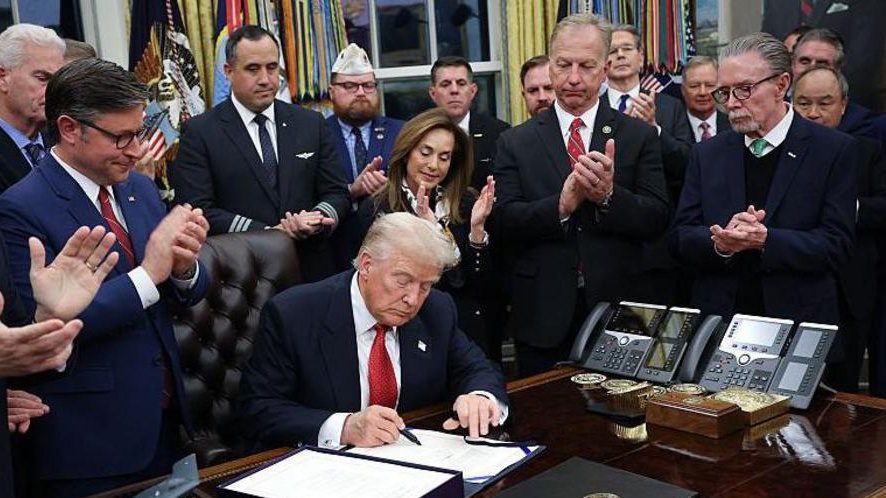
United States President Donald Trump has signed a long-awaited federal spending bill, officially ending the 43-day government shutdown the longest in the nation’s history. The move came less than two hours after the House of Representatives passed the bill by a 222–209 vote, following earlier approval in the Senate.
“With my signature, the federal government will now resume normal operations,” Trump said late Wednesday, vowing to continue efforts to reduce living costs.
The bill funds federal operations through January 30, allowing roughly 670,000 furloughed civil servants to return to work while another 670,000 who worked without pay will receive back wages. The reopening is expected to bring relief to millions of American families and help stabilize the country’s air travel industry ahead of the busy Thanksgiving season.
Partial Resolution but Lingering Divisions
Despite restoring government functions, the deal leaves key disputes unresolved notably, health insurance subsidies for 24 million Americans under the Affordable Care Act. The Trump administration has said it will not renew the subsidies when they expire at year’s end, setting the stage for another confrontation in Congress.
A Senate vote on healthcare funding is expected in December. In the meantime, both Republicans and Democrats have traded blame over the shutdown’s political and economic fallout.
A Reuters/Ipsos poll released on Wednesday found that 50% of Americans blamed Republicans for the closure, while 47% faulted Democrats. During the signing, Trump criticised his opponents, saying, “This is no way to run a country, and we can never let this happen again.”
Democratic lawmakers, however, argued that the new budget fails to address core issues of food aid and healthcare. Outgoing Representative Mikie Sherrill said in her final address, “Do not let this body become a ceremonial red stamp for an administration that takes food away from children and rips away healthcare.”
Economic Impact and Political Outlook
Economists estimate the shutdown shaved over 0.1% from US GDP every six weeks, though much of that lost output is expected to be recovered in the coming months. Still, the government will continue adding roughly $1.8 trillion annually to its $38 trillion national debt under the new spending plan.
Political analysts remain divided over whether the agreement represents a Republican victory. Former US Associate Deputy Attorney General Bruce Fein cautioned that another funding standoff may occur early next year, given deep divisions over federal spending priorities.
“The parties are still far apart,” Fein told Al Jazeera. “This vote is not a panacea for the country’s economic challenges.”
As the federal government reopens, both parties are bracing for renewed negotiations — and the possibility that the nation could again face a shutdown before the end of January.
