
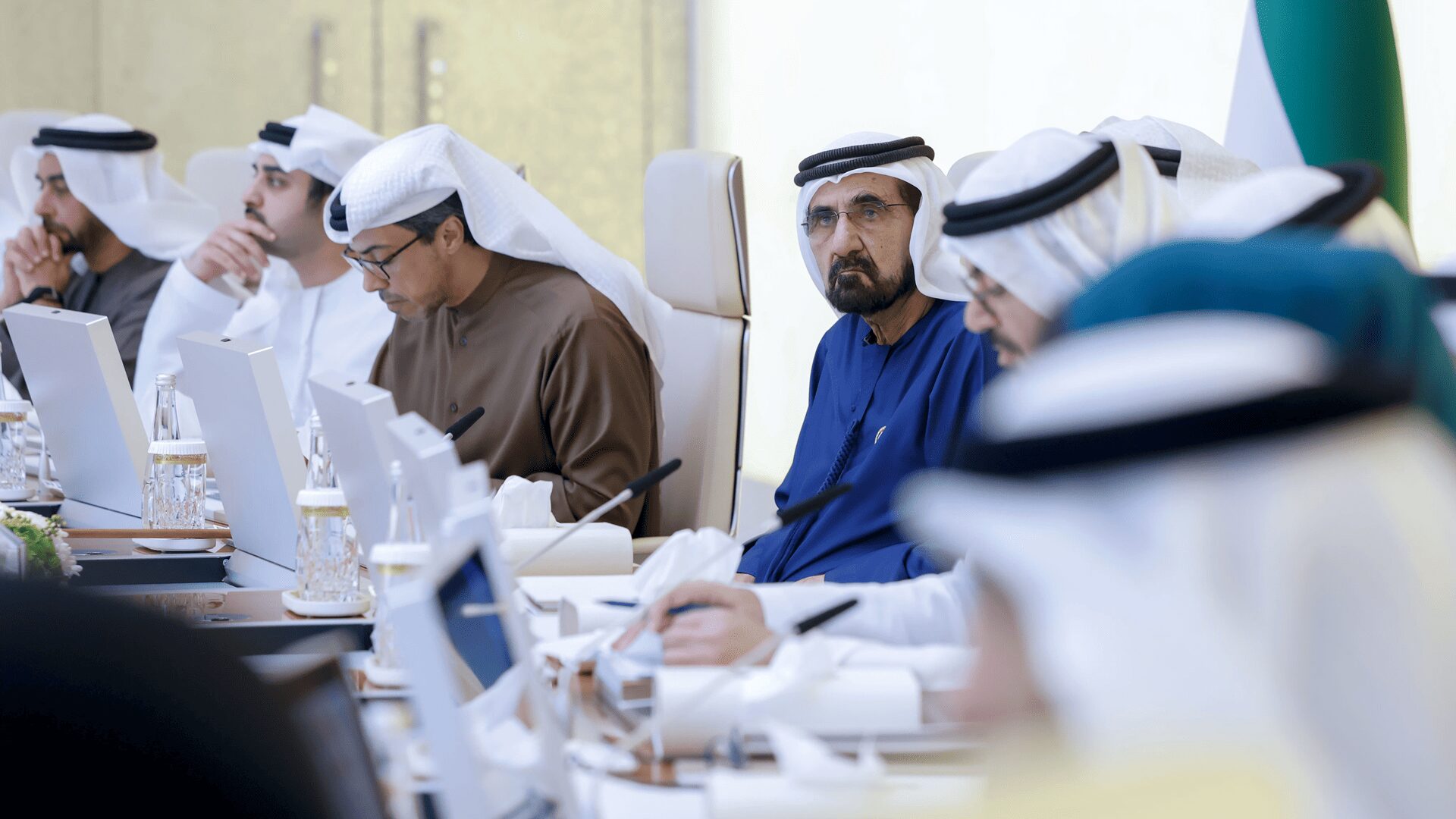
His Highness Sheikh Mohammed bin Rashid Al Maktoum, Vice President and Prime Minister of the UAE and Ruler of Dubai, chaired a Cabinet meeting at Qasr Al Watan in Abu Dhabi, attended by senior federal leaders. During the meeting, Sheikh Mohammed reviewed two decades of government achievements, highlighting the issuance of over 16,000 resolutions, management of work teams, and implementation of budgets exceeding AED 1.1 trillion. He emphasised that the federal government has restructured operations, modernised legislation and infrastructure, and advanced technology, investment, digital, and legal frameworks to support a new phase of development.
Sheikh Mohammed noted that under the leadership of President Sheikh Mohamed bin Zayed, the UAE has become a global role model, ranking highly in more than 280 development indices related to citizen well-being, education, health, and housing. Moreover, the UAE has strengthened its position in trade, artificial intelligence, space industries, sovereign assets, and as an international economic hub connecting East and West. He added that the country’s development model has been exported to over 55 countries, demonstrating the UAE’s capacity to influence global governance practices.
Strategic initiatives and long-term vision
Over the past 20 years, the UAE government has launched key initiatives, including the first Comprehensive Strategy in 2007, the Government Performance System in 2008, and six strategic planning cycles aligned with federal budgets. Vision 2021 and the National Agenda provided a roadmap for national growth, followed by the UAE Centennial 2071 plan and the “Preparing for the Next 50 Years” consultative programme. Sheikh Mohammed highlighted the “Principles of the 50” methodology, the “We Are the UAE 2031” plan, and a shift toward transformative projects and accelerated governmental work styles.
During this period, numerous programs supported government excellence, competitiveness, innovation, and public service. Notable initiatives included the Sheikh Khalifa Government Excellence Program, the Government Leaders Programme, the Mohammed bin Rashid Government Excellence Award, the World Government Summit, and the establishment of the AI ministry and a national AI strategy. In 2025, the government launched the Regulatory Intelligence Office and the UAE Legislation Platform, integrating artificial intelligence to create a dynamic legislative framework. Furthermore, more than 350 policies and strategies were adopted across various sectors.
Economic growth, social development, and international engagement
The UAE’s real GDP grew by 94% from AED 918 billion in 2006 to over AED 1.77 trillion in 2024, while non-oil foreign trade surged 599% and non-oil exports increased 1,827% over the same period. Labour market developments included a 45.76% increase in establishments, a 101.76% rise in total workforce, and a doubling of women’s participation. The Cabinet also discussed updates to the National Plan for Cultural Heritage (2026–2036), the UAE Tourism Strategy 2031, and the Circular Economy Policy 2031, with a focus on green procurement, water reuse, and incentives for a circular economy.
The government approved policies to enhance healthcare for people with disabilities and established a Higher Committee on Anti-Money Laundering, Countering Terrorism Financing, and Proliferation Financing, chaired by Sheikh Abdullah bin Zayed Al Nahyan. In addition, the Cabinet ratified international agreements with Tajikistan and Slovakia, and approved the negotiation of 21 further MoUs, reinforcing the UAE’s global partnerships and economic engagement.
