
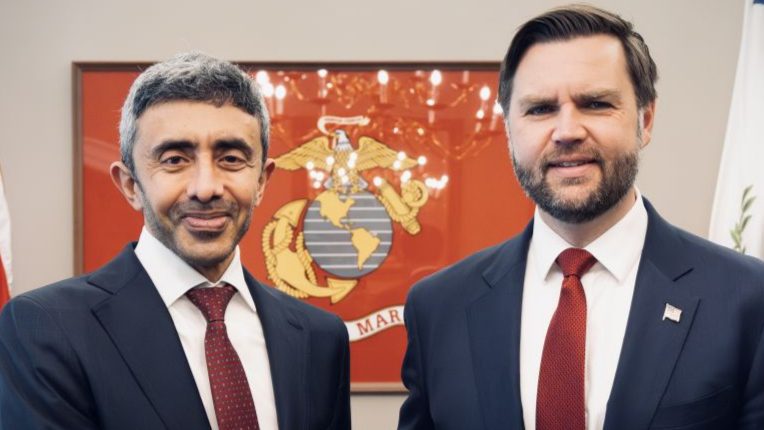
H.H. Sheikh Abdullah bin Zayed Al Nahyan, Deputy Prime Minister and Minister of Foreign Affairs of the UAE, concluded an official visit to Washington, DC, where he engaged in high-level bilateral discussions with senior U.S. Administration officials and Members of the Senate.
The meetings focused on maintaining regional stability, combating extremism, and further deepening the UAE–U.S. strategic partnership.
During his meeting with Vice President JD Vance, H.H. Sheikh Abdullah reaffirmed the long-standing strategic alliance between the UAE and the United States, highlighting collaboration in economic growth, advanced technology, energy security, defence, and joint efforts to promote regional stability.
H.H. Sheikh Abdullah also underscored the UAE’s proactive role in the Middle East, promoting diplomacy, facilitating humanitarian assistance, and countering the spread of extremist ideologies.
Both parties shared perspectives on regional security challenges, stressing the importance of avoiding escalation, keeping communication channels open, and pursuing diplomatic solutions to ensure long-term stability.
H.H. Sheikh Abdullah met with a range of senior officials, including Secretary of State Marco Rubio, Secretary of the Treasury Scott Bessent, Secretary of Commerce Howard Lutnick, Secretary of the Interior Doug Burgum, Senior Advisor for Arab and African Affairs Massad Boulos, Undersecretary for Economic Affairs Jacob Helberg, and Special Envoy to Monitor and Combat Antisemitism Rabbi Yehuda Kaploun.
Talks with the senior Trump Administration officials highlighted significant progress on the UAE’s commitment to invest $1.4 trillion in the U.S. over the next decade, building upon over $1 trillion already invested. Discussions focused on enhancing bilateral ties, promoting trade, and expanding cooperation in artificial intelligence and advanced technologies.
In 2025, UAE–U.S. bilateral trade reached $39 billion. The UAE has been the United States’ top export market in the MENA region since 2009 and remains one of the few countries with which the U.S. maintains a consistent global trade surplus.
