
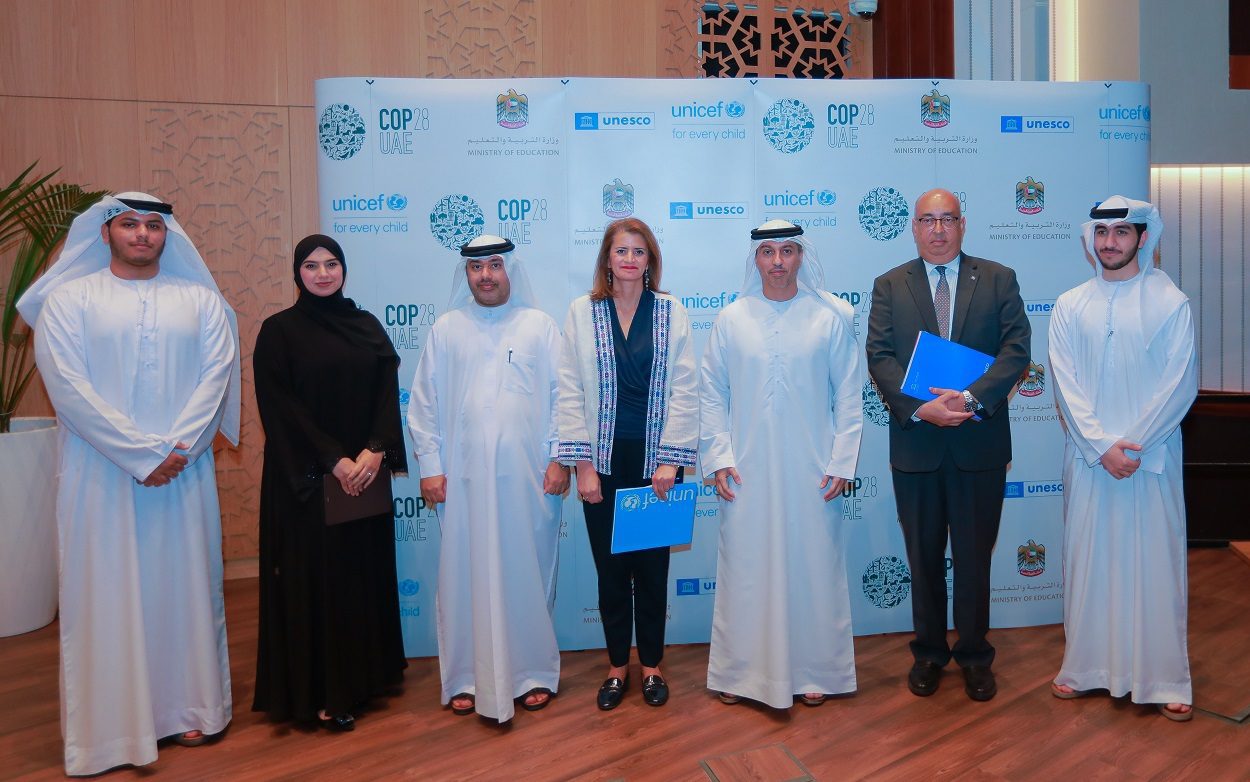
The Ministry of Education (MoE) has revealed the UAE’s Green Education Partnership Roadmap ahead of COP28 during a conference attended by senior officials from MoE and representatives from its local and international partners, as well as H.E. Dr. Ahmad Belhoul Al Falasi, Minister of Education; H.E Dr. Amna Al Dahak Al Shamsi, Assistant Under-Secretary of the Ministry of Education for the Care and Building Capacity Sector; Salah Khaled, Director of the UNESCO Regional Office for the Gulf States and Yemen; and Jumana Haj-Ahmad, UNICEF Gulf Deputy Representative.
Dr. Al Falasi highlighted the significance of COP28 in providing a guideline for utilizing education to attain sustainable development objectives and tackle climate change, as well as raising awareness and discussing solutions to its impacts. He stressed the significance of worldwide collaboration to incorporate the climate agenda into education and coordinate efforts to combat climate change. Furthermore, he noted that the UAE aimed to develop a practical and adaptable roadmap that countries worldwide could customize, adjust to, and benefit from in educating students and educators about climate change, according to WAM.
Dr. Al Falasi stated, “Individual behaviours toward climate change are still the key to making a real impact, and with that comes the significant role of education in shifting minds, actions, and attitudes about the environment today, and in the future. At the Ministry of Education, we have a critical role to play to advance the role of education in addressing climate change, by building environment-friendly curricula and schools and training educators to build sustainable green communities. The UAE’s hosting of COP28 presents another opportunity to highlight the country’s efforts in this field and mobilise international efforts to include green education within educational systems in the region and the world.”
H.E. Shamma bint Suhail Faris Al Mazrui, Minister of Community Development and Vice Chairman of the Arab Youth Centre, who is also the COP28 Youth Climate Champion, has welcomed the launch of the Green Education Partnership Roadmap. Al Mazrui said that the UAE is providing the foundations of environmental education to equip the younger generation with knowledge and skills to build a safer and sustainable future. She added that educating young people and fostering a love for the environment is a priority for the UAE’s wise leadership, as they are the forerunners of environmental action.
The Green Education Partnership Roadmap includes the UAE Green Education Partnership, an initiative aimed at incorporating the climate agenda into the UAE’s education system and achieving sustainable development goals.
At the press conference, the Ministry of Education (MoE) signed Memorandums of Understanding (MoUs) with the United Nations Educational, Scientific, and Cultural Organisation (UNESCO) and the United Nations International Children’s Emergency Fund (UNICEF) to advance climate education and action among children and youth at, during, and after COP28. The MoE also announced that it is creating the first Education Pavilion in the history of COP.
Salah Khaled, who serves as the Director of the UNESCO Regional Office for the Gulf States and Yemen, expressed his pleasure in announcing the collaboration between UNESCO and the Ministry of Education in the UAE to promote commitment to climate change and education during the upcoming COP28. He added that, under the leadership of the UAE, UNESCO would assist in organizing a high-level advocacy meeting with leaders of member states to discuss the role of education in addressing the climate crisis, as well as convene the first co-creation meeting of the Greening Education Partnership (GEP) Multi-Partner Trust Fund. The GEP was established at last year’s Transforming Education Summit with the goal of addressing climate change, one of the most pressing issues of our time.
“UNESCO will work closely with the Ministry in co-designing the first Education Pavilion in the history of COP together with the Greening Education Partnership (GEP). Finally, UNESCO will collaborate with the Ministry on raising awareness of educators and learners about the importance of safeguarding oases, an exceptional eco-system and observatory of climate change, that is a common feature throughout several Arab countries”, Salah Khaled added.
Jumana Haj-Ahmad, UNICEF Gulf Deputy Representative, said. “We at UNICEF are pleased to join the Greening Capacities Initiative led by the Ministry of Education in the United Arab Emirates. We look forward to a strategic partnership that aims to provide children and young people with climate education and green skills, which are crucial to help them adapt to and prepare for the impacts of climate change. Through this partnership and in the lead up to COP28, UNICEF will support training of school principals and teachers in all of the schools of UAE on climate education. Open source learning materials will also be available for educators in the UAE and abroad.”
“At UNICEF we see the climate crisis as a crisis of children’s rights. Nearly every child around the world is exposed to climate and environmental hazards. Children and young people will face the full devastating consequences of the climate crisis, water insecurity, and other disasters which they had little to no hand in causing. Therefore, our duty towards all young people and future generations is to involve them in all negotiations and decision-making processes related to climate change at the national, regional and international levels,” she added.
The Green Education Partnership Roadmap outlines several environmentally-friendly initiatives that the MoE plans to achieve before and after COP28. One of these is to make 50% of all schools and campuses in the UAE green accredited, while over 2,400 educators and 1,400 principals will receive training. Two initiatives, “Children’s Voice” and “Educator’s Voice,” will also be launched to allow students and educators to participate in decision-making regarding environmental issues.
To promote the importance of safeguarding oasis systems in the Arab world, the MoE will collaborate with UNESCO to establish a Multi-Partner Trust Fund for Greening Education, which the UAE will champion. The MoE will work across four pillars to achieve its Green Education Partnership goals: Greening Schools, Greening Learning, Greening Capacity, and Greening Communities.
