
Kuwait Petroleum International (Q8) has initiated the construction of Rome’s inaugural hydrogen refueling station, according to a recent press release.
Q8 stated that it will collaborate with the specialized Maire Group to launch the hydrogen refueling station, emphasizing its alignment with Kuwait Petroleum Corporation’s (KPC) strategy of offering clean and sustainable petroleum products derived from renewable resources.
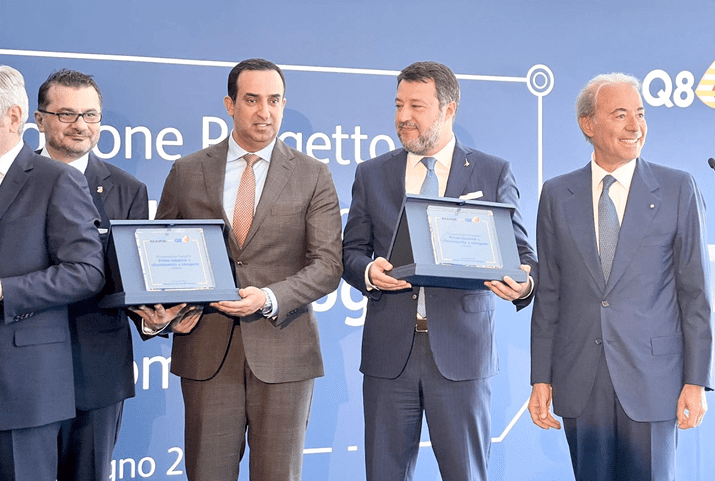
Representatives from Q8, Italian government officials, and leaders from the energy and transportation sectors attended the ceremony announcing the commencement of the project.
The hydrogen fuel provision will facilitate the transformation of the station into an integrated hub supporting eco-friendly and low-emission mobility.
Upon completing the delivery infrastructure by 2026, Q8 will supplement its existing services, including conventional fuels such as liquefied petroleum gas and methane, and electric vehicle charging, with hydrogen fuel.
The company highlighted that this initiative would enable Q8 customers to travel approximately 100 kilometres with just one kilogram of hydrogen fuel for small vehicles or eight kilograms for large buses, resulting in a carbon dioxide emissions reduction exceeding 75 percent compared to conventional fuels.
“This project was developed in cooperation with the Italian government within the framework of its national plan for economic recovery and resilience aimed at developing a sustainable mobility network by supporting renewable energy and hydrogen projects,” it stated, unveiling that it would be funded equally by the partners and the European Union’s Fund for Future Generations.”
The statement quoted the CEO of Kuwait Petroleum International, Eng. Shafi Al-Ajmi, as saying, “Italy is considered the most important European market for the company due to the volume of its operations there: over 2,800, fueling stations in addition to the Naples Depot and the Milazzo refinery”.
“We will continue to implement KPC’s approach to the energy transition for the year 2050, by supporting the global movement to reduce harmful gas emissions in all of our global operations,” he asserted.
The stakeholders commended and congratulated the CEO of Q8 Italy and its leadership for their significant role and dedicated efforts in achieving this milestone.
For his part, Executive Director of Q8 Italy Eng. Fadhel Al-Faraj, said, “Q8-Italy seeks to transform from a conventional fuel provider into a diversified energy company, within the framework of its energy transformation strategy.” “We welcome all sustainable products as they help us achieve our first goal, which is to respond to the needs of our customers, thus preserving our market share, and our second goal which is to establish a sustainable supply network for future vehicles in Italy,” he concluded.
Meanwhile, Kuwaiti Ambassador to Italy Nasser Al-Qahtani hailed Q8’s initiative to establish the first hydrogen refueling station in Rome and its contribution to the transition to clean sustainable energy.
“The adoption of this new pioneering step by Kuwait Petroleum International and its branch in Italy to contribute to the development of the Italian network for the transportation, storage and use of renewable products is directed towards transforming the vast Q8 network stations into an integrated center for renewable products with low emissions,” Ambassador Al-Qahtani told KUNA.”
The stakeholders emphasized that this step highlights the significant contribution of the Kuwaiti company towards environmental sustainability goals and aligns with Italian and European energy transition policies.
The joint investment with the Italian government, as part of its national plan for economic recovery, flexibility, and sustainable mobility, showcases the role played by the Kuwaiti company.
Al-Qahtani praised KPC’s strategy of achieving energy transition by 2050, which supports global efforts in reducing harmful emissions.
Additionally, the stakeholders acknowledged the positive impact of Q8’s investments in Italy on the growth of the Italian economy and the strengthening of bilateral relations over the past three decades.
