
Dubai’s rental market recorded stable performance in the first quarter of 2026, supported by regulatory strength and resilient economic fundamentals. Moreover, the market continued to show steady activity within an environment that adapts efficiently and reinforces investor confidence.
The performance reflects continued policy focus on strengthening economic resilience and supporting sustainable growth. Additionally, the market maintained balanced momentum while reinforcing Dubai’s ability to sustain stable economic expansion.
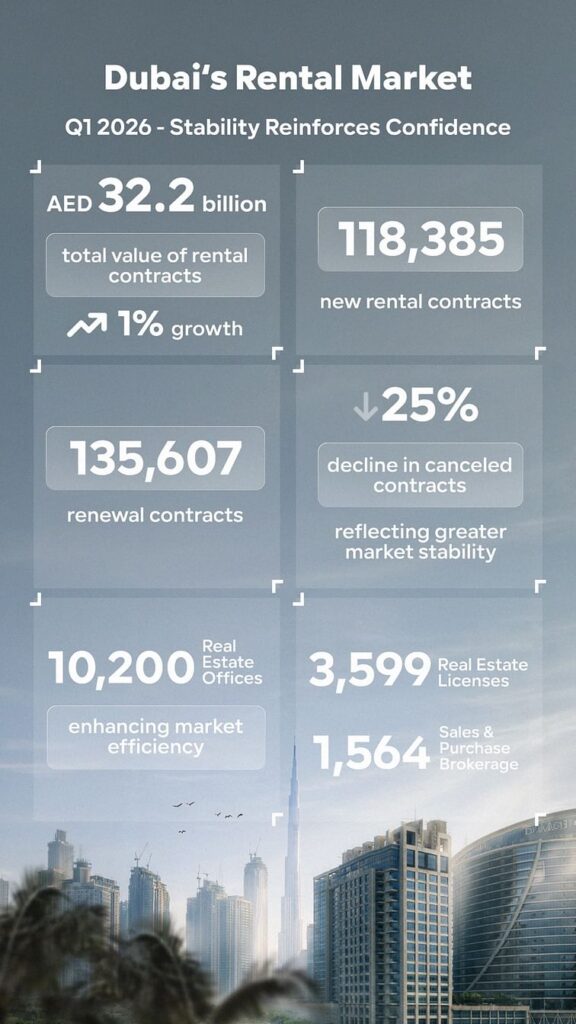
According to Dubai Land Department data, the total value of rental contracts reached AED32.2bn in Q1 2026. Furthermore, the results reflected sustained activity supported by clear legislation and an integrated regulatory framework governing market relationships.
New rental contracts totalled 118,385, while renewal contracts reached 135,607. As a result, the figures indicate stable landlord-tenant engagement and continued market depth.
Cancelled contracts declined by 25% during the quarter. Moreover, the drop points to stronger rental-cycle stability and reduced volatility.
The number of real estate offices operating in the market reached 10,200. Additionally, the expanded base of market participants supported service quality and improved operational efficiency.
Licensing growth supports market activity
A total of 3,599 real estate licences were registered during the quarter, covering a broad range of real estate activities. Furthermore, sales and purchase brokerage licences led the market with 1,564, followed by leasing brokerage licences with 928.
Transaction follow-up services accounted for 376 licences, while real estate development activity recorded 128 licences. Moreover, other licences covered services including owners’ association supervision, consultancy, property leasing and management, mortgage brokerage, business centres, valuation, surveying, and public auction organisation.
This broad licensing activity reflects the market’s integration and the continued expansion of Dubai’s real estate service ecosystem. Additionally, the diversity of activities highlights the sector’s capacity to meet evolving stakeholder requirements.
Balanced demand supports sector resilience
The latest indicators show Dubai’s rental market remains anchored within a well-structured ecosystem combining development, investment, and regulation. Moreover, the market continues to operate under a balanced supply-demand environment supported by diversified offerings and sustained project activity.
As a result, Dubai’s real estate sector continues to strengthen its role as a key driver of economic growth. Additionally, a flexible regulatory environment and improving investor confidence continue to support market continuity and long-term sustainability.
