
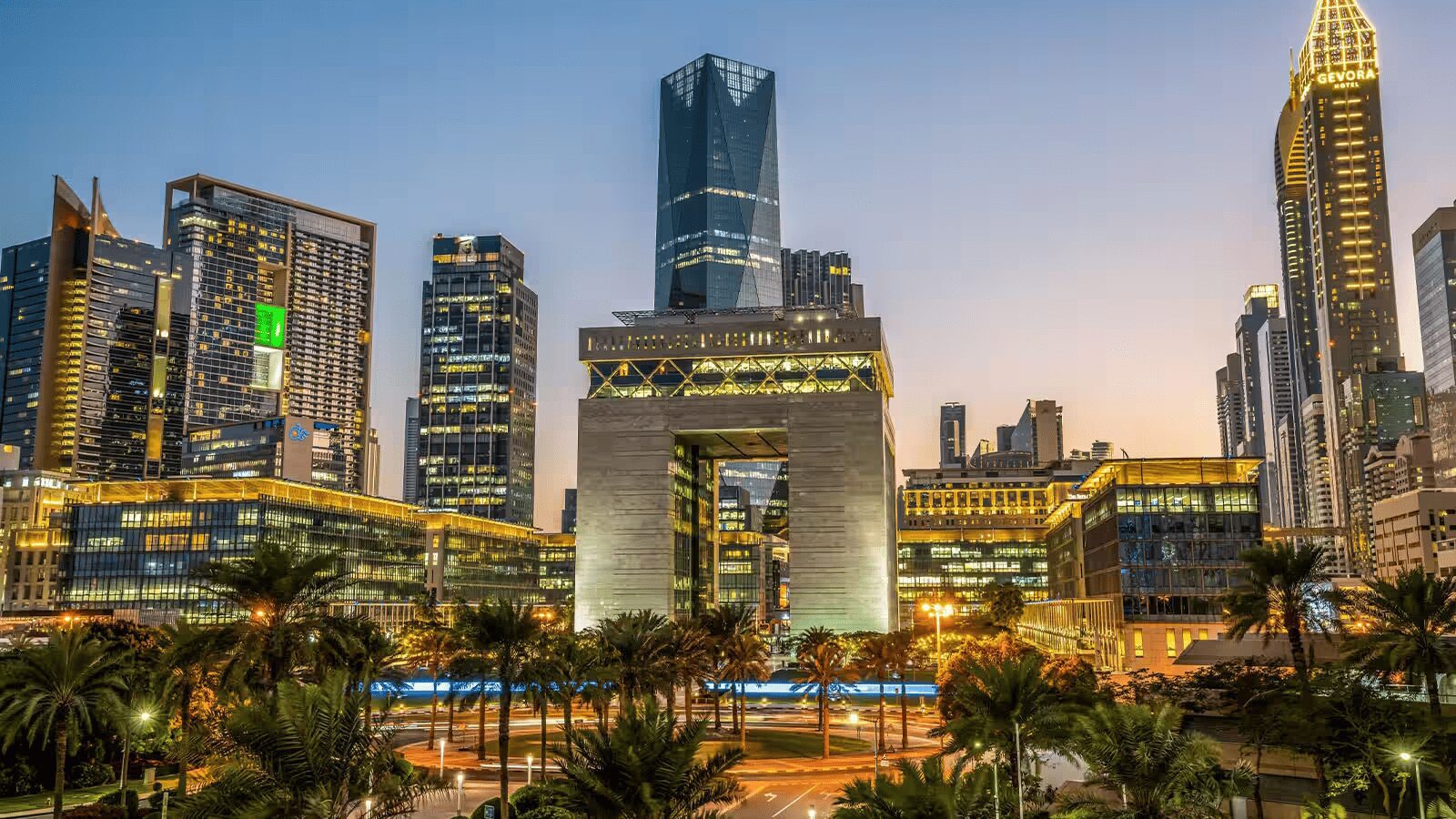
Dubai is rapidly strengthening its position as a next-generation financial hub, and it is advancing at a pace that now exceeds long-established centres like New York, London and Hong Kong. The latest findings show that the city continues to benefit from a powerful combination of growth factors that reinforce its competitiveness. As a result, Dubai now hosts more than 8,000 active registered companies along with over 1,500 firms in FinTech, AI and innovation. This mix places the emirate firmly among the world’s leading modern finance destinations.
Moreover, Dubai now has the region’s highest concentration of regulated financial firms, with more than 1,000 supervised entities. This density strengthens its role in global finance, digital assets and growth-stage technology. Because of this, Dubai’s reputation as a progressive and opportunity-rich ecosystem keeps rising.
Findings from the Latest Financial Outlook
A new edition of a major financial report, presented during a global webinar attended by over 600 senior executives, highlights how Dubai and other emerging hubs are outperforming traditional financial cities. The study explains that rising centres are gaining momentum due to strategic adaptability, advanced regulatory structures and business-friendly environments. Meanwhile, older hubs face challenges such as higher operational costs, ageing infrastructure, political uncertainty and reduced regulatory agility.
Dubai’s impressive rise is also reflected across global benchmarking tools. For example, its performance in the Global Financial Centres Index places it just outside the worldwide top 10. Professor Michael Mainelli noted Dubai’s long-term climb: “When we launched the index in 2005, the average centre scored 567 points, and Dubai was close at 570… Dubai has moved significantly from 570 to 748 points, placing it just outside the global top 10. Back then, Dubai was three points above average; now, it is 51 points ahead.”
The research outlines four pillars shaping the future of financial hubs: talent attraction, financial infrastructure and adaptability, regulation and governance, and connectivity. Dubai continues to invest heavily across these areas. Its Common Law framework, specialised regulations and expanding innovation ecosystem further support this progress. Arif Amiri emphasised that new centres are accelerating through reform and fresh models, adding that Dubai holds “unique characteristics that give it an exceptional competitive advantage”.
Global Perspectives on Dubai’s Appeal
International industry leaders interviewed for the report offered deeper insight into why global professionals increasingly choose Dubai. Dr. Jochen Biedermann explained that quality of life elements — including schools, safety and green spaces — are becoming as important as business competitiveness. Additionally, Wolfgang Engel highlighted that emerging hubs can serve as partners in shaping a more resilient financial system. He pointed to opportunities in areas such as FinTech standards, cross-border data flows and climate finance.
Furthermore, firms in the city’s financial district have already raised more than $4.2bn in investments, which reinforces Dubai’s status as the region’s most active growth-stage tech environment. This momentum also signals a broader shift toward a more distributed global financial landscape. As financial centres become increasingly interconnected, Dubai is positioned to play a defining role in this evolving network.
