
A new report released by the International Renewable Energy Agency (IRENA), in partnership with the COP30 Brazilian Presidency and the Global Renewables Alliance, revealed that global renewable energy capacity reached a record 582 gigawatts (GW) in 2024, with solar energy contributing 452GW to the total.
This achievement marks a major step towards meeting the UAE Consensus target set during COP28 in Dubai, which calls for tripling global renewable energy capacity to 11.2 terawatts (TW) by 2030.
The impressive growth underscores the world’s steady progress towards global climate objectives, highlighting the need to sustain this momentum by adding approximately 1,122GW of renewable capacity annually to meet the 2030 target.
Demonstrating its continued leadership in the clean energy transition, the UAE remains at the forefront of global efforts to expand renewable energy through large-scale projects that set new standards for innovation and sustainability.
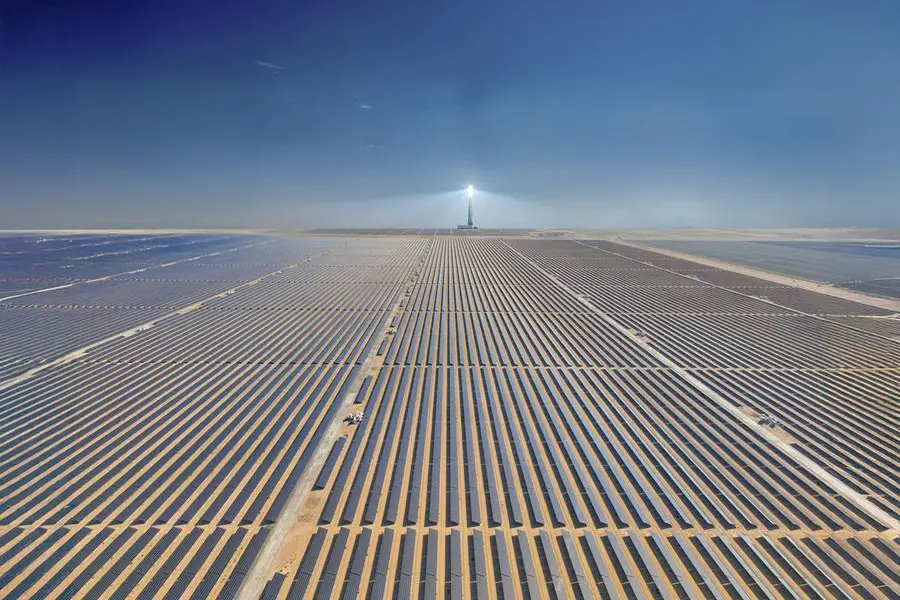
One such landmark initiative is the Mohammed bin Rashid Al Maktoum Solar Park, launched in 2012 by His Highness Sheikh Mohammed bin Rashid Al Maktoum, Vice President, Prime Minister and Ruler of Dubai, and developed by Dubai Electricity and Water Authority (DEWA). It serves as a cornerstone of the UAE’s long-term strategy to build a sustainable energy future based on renewable sources.
The solar park’s current production capacity stands at 3,860MW. By 2030, this figure will surpass 8,000MW—an increase of 60 percent from the original target of 5,000MW.
Saeed Mohammed Al Tayer, MD & CEO of DEWA, stated, “Guided by the vision of President His Highness Sheikh Mohamed bin Zayed Al Nahyan and His Highness Sheikh Mohammed bin Rashid Al Maktoum, we continue to strengthen the UAE’s position as a global leader in clean and renewable energy. The Mohammed bin Rashid Al Maktoum Solar Park represents a world-class model for sustainable infrastructure and future-oriented energy systems, supporting Dubai’s green economy based on knowledge and innovation. The park’s capacity has now reached 3,860MW and will exceed 8,000MW by 2030. Clean energy currently accounts for 21.5 percent of DEWA’s total capacity and is expected to reach 36 percent by 2030, compared to 25 percent in the original plan—helping reduce over 8.5 million tonnes of carbon emissions annually.”
He added, “The solar park supports the UAE Net Zero by 2050 Strategic Initiative, the Dubai Clean Energy Strategy 2050, and the Dubai Net Zero Carbon Emissions Strategy 2050, which target 100 percent clean energy generation by mid-century. We implement the solar park through public-private partnerships under the Independent Power Producer (IPP) model—an innovative framework that combines government vision, technological advancement and investment efficiency. This approach demonstrates Dubai’s flexibility in adopting creative financing and operational models that accelerate the shift to renewable energy while maintaining economic and environmental balance. By incorporating advanced technologies, including artificial intelligence, we have enhanced photovoltaic panel efficiency from 11 to 24 percent, significantly boosting energy output without requiring additional land.”
The Mohammed bin Rashid Al Maktoum Solar Park is more than a large-scale renewable project—it serves as a hub for innovation, research, and sustainability, and acts as a living laboratory for the development of cutting-edge clean energy technologies. The initiative reflects Dubai’s vision to position itself as a global hub for the green economy and a benchmark for integrating strategic policy, technology, and investment to create a sustainable, innovation-driven future.
DEWA has successfully completed five phases of the solar park and is currently developing the sixth. The authority has also invited qualified firms and consortiums to submit proposals for the seventh phase, to be implemented under the IPP model. This phase will add 2,000MW of photovoltaic solar capacity and include a 1,400MW battery storage system with a six-hour capacity—making it one of the world’s largest solar-plus-storage projects.
