
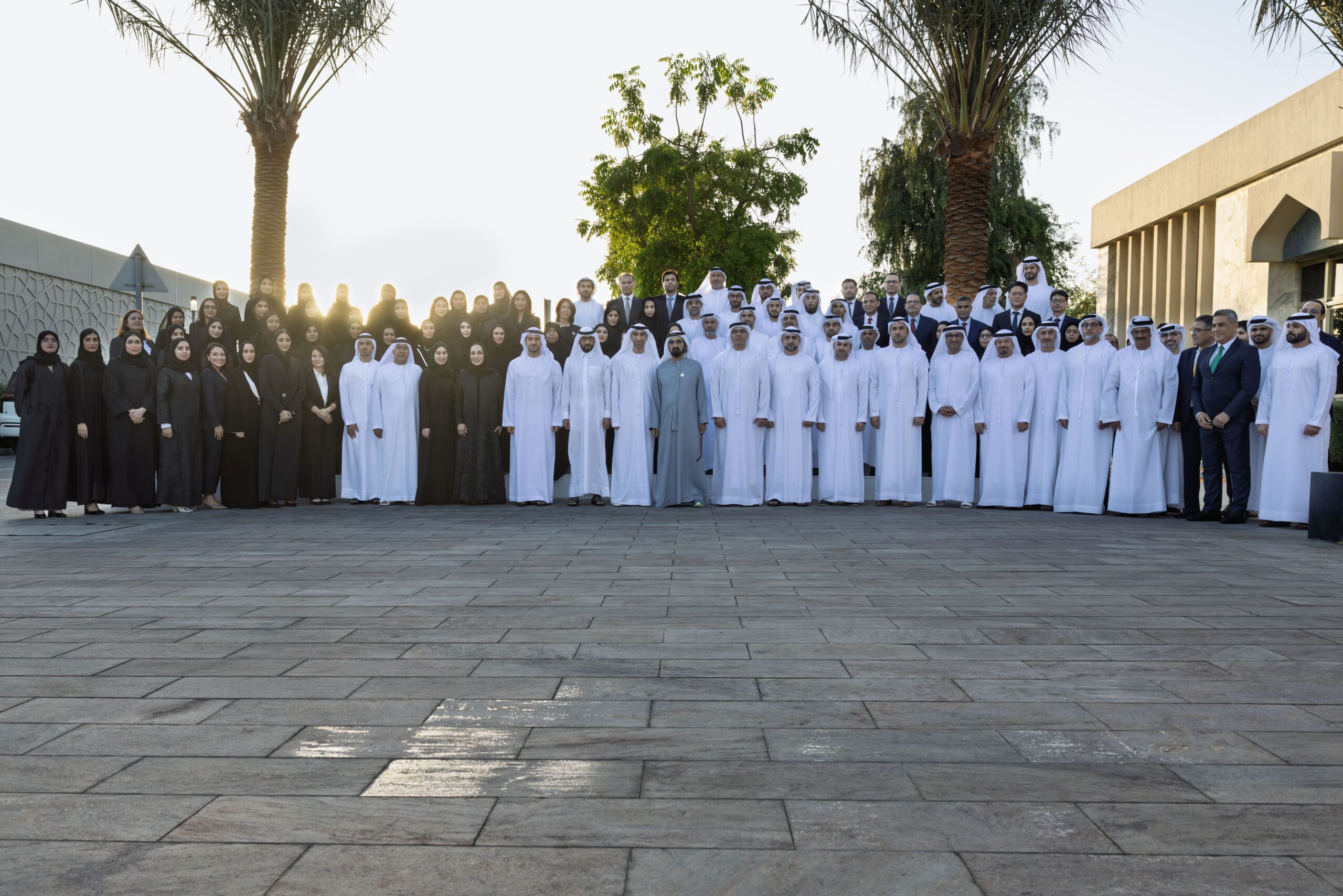
His Highness Sheikh Mohammed bin Rashid Al Maktoum, Vice President, Prime Minister of the UAE, and Ruler of Dubai, met with the Ministry of Economy’s Foreign Trade team and the CEPA negotiation unit on Wednesday to commend their instrumental role in elevating the UAE’s trade performance to unprecedented levels in 2024.
Held at Union House in Dubai, the gathering recognised the teams’ contribution to a record AED 5.23 trillion in total trade, with a surplus exceeding AED 490 billion. The meeting was attended by several high-ranking officials and dignitaries, including H.H. Sheikh Hamdan bin Mohammed bin Rashid Al Maktoum, Crown Prince of Dubai, and H.H. Sheikh Maktoum bin Mohammed bin Rashid Al Maktoum, Deputy Prime Minister and Minister of Finance.
Foreign Trade as a Pillar of Civilisation and Growth
During the discussion, Sheikh Mohammed underscored that trade has always been a cornerstone of flourishing civilisations and remains a primary engine of sustainable economic development. He attributed the UAE’s trade success to its proactive vision, strategic global partnerships, policy flexibility, and the relentless dedication of its economic teams.
“Our geography is not a boundary—it is a launchpad for ambition,” Sheikh Mohammed said. He highlighted how the UAE continues to drive growth by expanding access to new markets and reinforcing its role as a global trade facilitator.
CEPA Strategy Positions UAE at Global Trade Forefront
Dr. Thani Al Zeyoudi, Minister of State for Foreign Trade, joined the session, which celebrated the UAE’s landmark achievement of signing 21 Comprehensive Economic Partnership Agreements (CEPAs). These agreements span key regions across Asia, Africa, and Latin America, collectively granting access to markets that represent about 25% of the world’s population.
These trade accords are part of the broader ‘Projects of the 50’ agenda, aimed at strengthening the UAE’s non-oil trade foundation. As a result, the UAE now accounts for 41.4% of total goods exports in the Middle East, ranking 11th globally in goods exports and 13th in services exports.
“Sheikh Mohammed reaffirmed that the UAE is not simply adapting to global trade changes—it is actively shaping them,” according to official remarks from the meeting.
Trade Vision Linked to Broader National Innovation Goals
Also in attendance were key figures from the UAE’s public and private sectors, including Lt. General H.H. Sheikh Ahmed bin Rashid Al Maktoum, H.H. Sheikh Ahmed bin Saeed Al Maktoum, and H.H. Sheikha Latifa bint Mohammed bin Rashid Al Maktoum, as well as ministers, investors, and National Council members. Discussions spanned the UAE’s economic outlook, private sector engagement, and innovation as a driver of sustainable development.
In a related session, Sarah Al Amiri, Minister of Education, presented a lecture on AI integration into public education curricula, illustrating how the government is preparing youth for the transformative impact of emerging technologies.
She emphasised that the UAE’s education system must evolve to ensure the next generation can master tools that influence not just work and productivity but also the social fabric of future societies.
Bridging Trade, Innovation, and Future Readiness
The meeting served as both a celebration of past achievements and a strategic check-in on the UAE’s trajectory. By aligning trade policy with education and innovation, the country is ensuring that its position as a global trade leader is sustainable and future-ready.
With robust economic diplomacy, strategic CEPA rollouts, and a deep commitment to digital transformation, the UAE is writing a compelling chapter in global economic leadership—one that is both anchored in vision and propelled by execution.
