
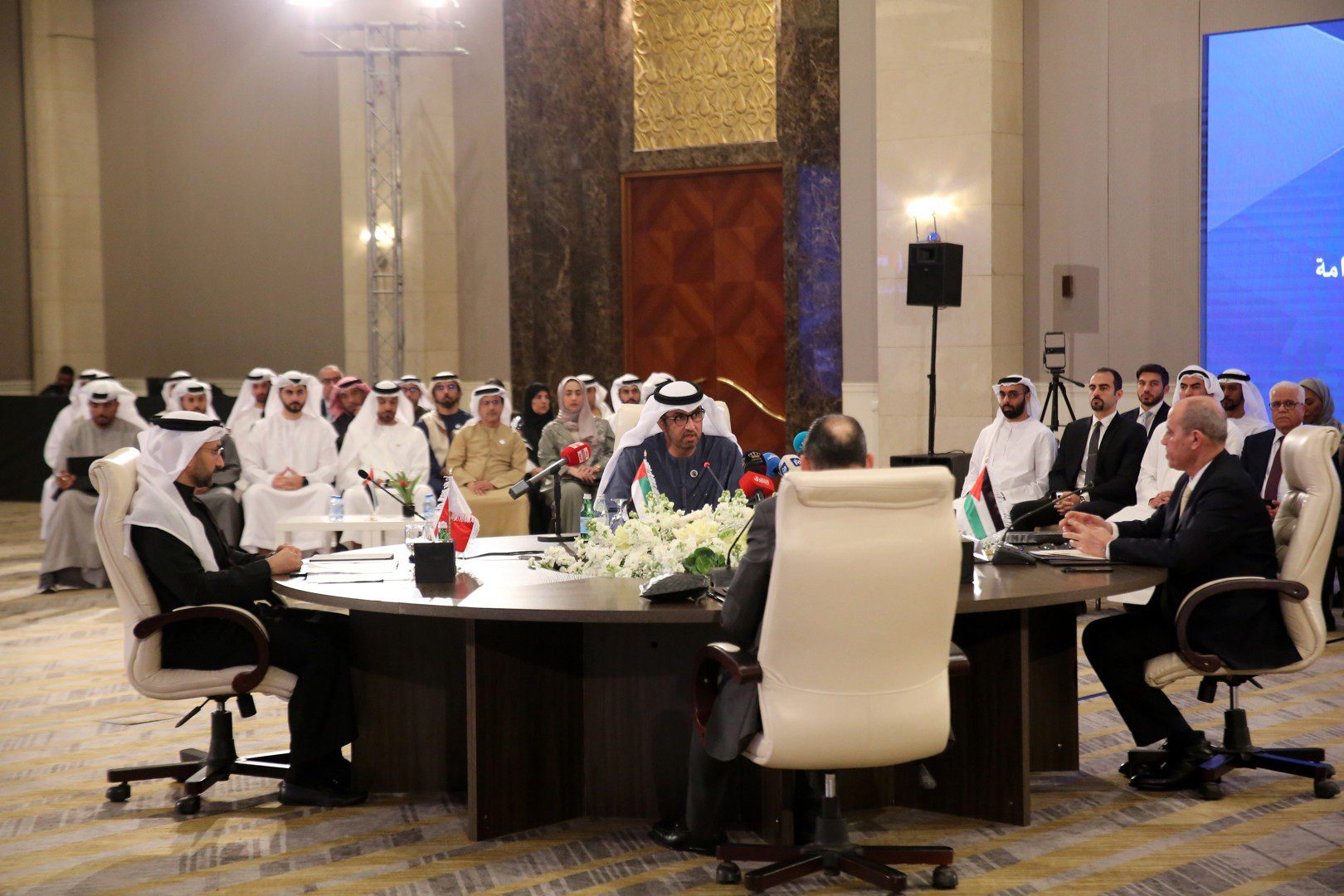
Middle Eastern companies from the UAE, Egypt, Jordan, and Bahrain have inked industrial deals worth over $2B at the third Higher Committee meeting of the Industrial Partnership for Sustainable Economic Development held in Amman on Sunday.
The event saw the presence of various ministers, including UAE’s Minister of Industry and Advanced Technology, H.E. Dr. Sultan bin Ahmed Al Jaber, who also serves as the UAE’s special envoy for climate change, along with the industrial ministers from Egypt, Jordan, and Bahrain. In total, 12 agreements were signed across nine industrial projects, expected to create 13,000 job opportunities and increase the national GDP of participating countries by over $1.6B.
Jordan’s Prime Minister, Dr. Bisher Al-Khasawneh, attended the partnership agreements’ signing ceremony and highlighted the significance of this partnership in promoting economic development and strengthening bilateral relations, emphasizing the crucial role of the industrial sector in all participating countries.
Dr Al-Khasawneh met with the ministers of the partner countries and stressed the importance of this partnership in strengthening bilateral relations and economic development, along with the importance of the industrial sector’s role within participating countries, according to WAM.
Dr. Al Jaber said: “We are grateful for His Majesty King Abdullah II for his continuous support for UAE-Jordanian relations, and for his support of the Integrated Industrial Partnership for Sustainable Economic Development. We thank the government of Jordan and its people for their hospitality in hosting the third meeting of the Higher Committee for the Integrated Industrial Partnership for Sustainable Economic Development.
Dr. Al Jaber also said: “We are keen on collaborating and complementing regional efforts to achieve integrated sustainable economic development. The UAE is committed to enhancing collaboration with member states to ensure we all benefit from each other’s competitive advantages and capabilities.
“This partnership is beginning to yield tangible results. It represents an exceptional model for industrial partnerships among private sector companies. It is testament to our collective ability to plan, integrate, and progress towards achieving our objectives, all while we are still at the beginning of this fruitful partnership. We are confident that we will witness the development of many new projects in the future.”
He added: “We call on companies in our respective countries to enter these partnerships and put forward proposals for projects that benefit from the capabilities of our countries and from our competitive advantages, resources, and expertise. As governments, our responsibility is to support these projects, enhance partnerships and provide the economic environment that enables their success.”
For his part, Al Shamali, Jordan’s Minister of Industry, Trade and Supply, said: “Since launching this partnership, we have witnessed a multi-faceted boom that heralds the start of a profound and sustainable transformation in the relations between our industrial sectors. The first aspect of this shift was reflected in the economic discourse adopted by officials and media, who highlighted the benefits that our countries will reap through pursuing industrial integration. This is an integrated Arab effort directed by the highest political levels of the four countries”.
Eng. Ahmed Samir Saleh, Egypt’s Minister of Industry and Trade, underlined Egypt’s commitment to enhancing multilateral efforts with the UAE, Jordan and Bahrain to boost industrial integration among Arab nations and support economic relations.
“The economic crisis the world is currently experiencing demonstrates the necessity of achieving industrial integration among Arab states. It is clear we must strengthen regional partnerships and include the private sector as a major partner in implementing sustainable development plans and helping the Arab region to prosper”.
“Recent geopolitical and economic challenges demand stronger bonds among Arab nations and more robust economic partnerships. These partnerships can help to enhance resilience against future crises as well as achieve self-sufficiency and sustainable economic development.”
Soda Chemical Industries, an Egyptian company, revealed that it would invest $500M to establish a facility that produces sodium carbonate, also known as soda ash, which serves as a primary ingredient in numerous industries, including glass and detergent.
The plant is expected to produce 500,000 tons per year, and a strategic partnership was signed with Emirates Flat Glass Company, owned by Dubai Investments, to purchase the finished product.
M Glory Holding, a UAE-based automobile manufacturer, announced a large manufacturing project valued at $550M to establish three electric vehicle factories with specialized production and assembly lines in Egypt, Jordan, and the UAE.
The factories are expected to produce 40,000 compact crossover SUVs within the first three years of operation. M Glory Holding signed MoUs with Jordan Design and Development Bureau, Egypt’s Arab Organisation for Industrialization, and Bahrain’s GARMCO as manufacturing and supply partners. The partnership aligns with sustainability objectives and the UAE’s presidency of COP28.
CFC Group, owned by Emirati investors, revealed a plan to invest $400 million to establish an industrial complex in Egypt that produces fertilizers and chemicals. The company signed MoUs with Jordan’s Arab Potash and Egypt’s Misr Phosphate Company to supply raw materials. The complex is projected to produce half-a-ton of fodder and potash fertilizers, and 1.1 tons of chemicals annually.
Emirates Global Aluminium disclosed a $200M investment to establish a silicon metal plant with an annual production capacity of 55,000 tons in the UAE. The company signed an MoU with Jordan’s Manaseer Group to supply the required crystalline silica.
Manaseer Group announced the expansion of a $70M magnesium oxide plant in Jordan, which will have a total production capacity of 270,000 tonnes annually and will export to the UAE. Emirates Global Aluminium will purchase its product, and production is set to commence in 2024.
Globalpharma, based in the UAE, entered into a partnership with Nerhadou in Egypt to develop advanced technology for the manufacturing of medicines and supplements. The company also signed an agreement to transfer technology to two Jordanian firms, Savvy Pharma and Triumph, with a total investment of $60 million. Production capacity is anticipated to reach 5 million packages annually per product.
Itqan, a Jordanian company, revealed a technology transfer and contract manufacturing agreement with Globalpharma and ADCAN Pharma to produce syringes, aerosols, and inhalers. Additionally, it signed an MoU with Egypt’s Marcyrl to transfer technology to manufacture biosimilars in Jordan, with a total investment of $10M and the goal of launching products in Q4 2024.
Alpha Biotic, based in Bahrain, signed two MoUs for knowledge and technology transfer and contract manufacturing with Jordan’s Dar Al Dawa and Egypt’s EIPICO to produce general products, oncology products, medical solutions, and other pharmaceutical products. The project is expected to produce 350 million pills annually, with a total investment of $174M over two phases.
Lastly, Gulf Biotech, another Bahraini company, announced plans to establish a plant with a production capacity of 105 doses per year to manufacture raw materials for vaccines and other products at an investment value of $103M. Earlier this month, the company signed a technology transfer agreement with Egypt’s BioGeneric Pharma.
