
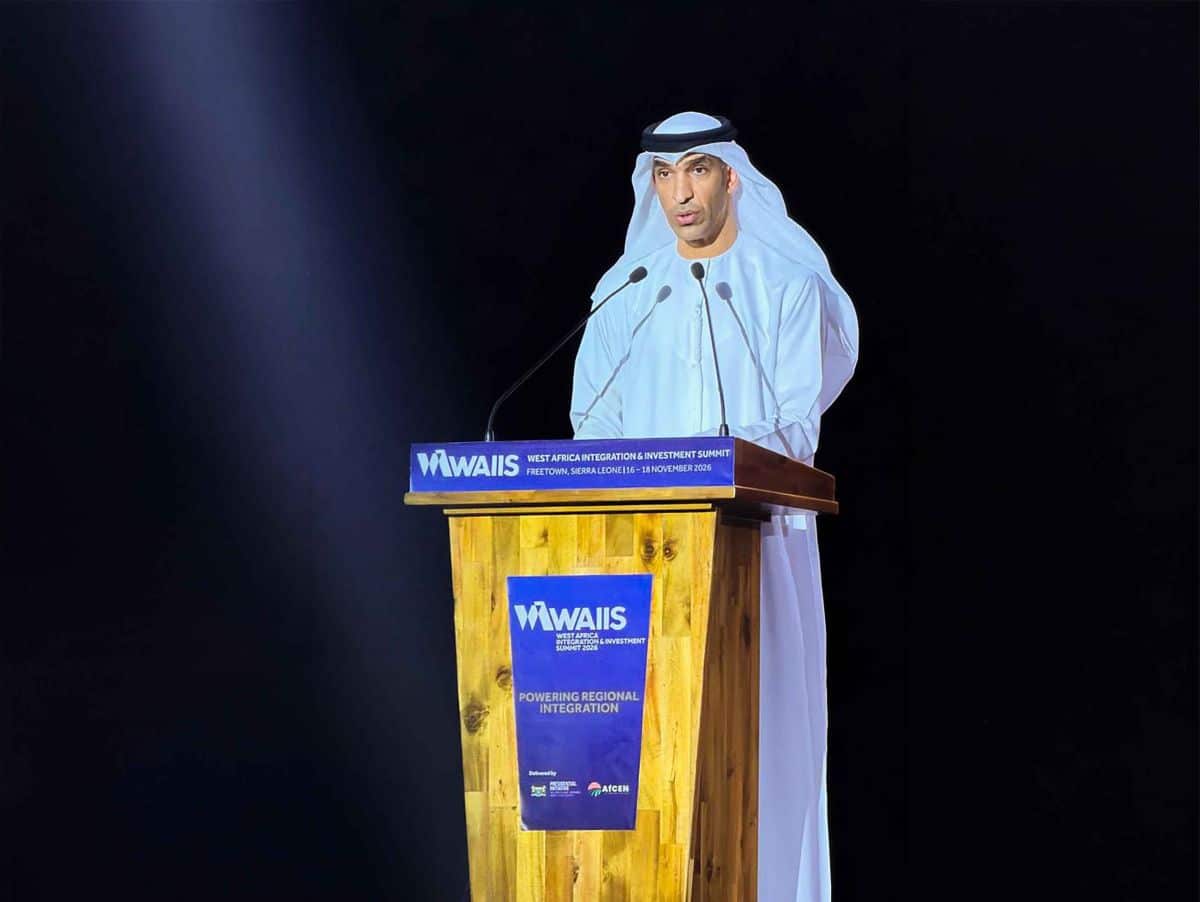
UAE Minister of Foreign Trade Dr Thani bin Ahmed Al Zeyoudi has highlighted growing opportunities for economic cooperation between the UAE and West African nations across key sectors, including energy and digital transformation, as he led a UAE delegation to the West Africa Integration and Investment Summit in Sierra Leone.
According to state news agency WAM, the potential areas of collaboration include energy, infrastructure, industry, food security, agriculture, minerals and natural resources, trade, logistics and digital transformation.
“West Africa is entering a new phase of economic integration, underpinned by a market of more than 450 million people, regional growth of 4.7 per cent, and a portfolio of investment projects valued at more than $180 billion,” Al Zeyoudi said.
“The UAE views West Africa as a trade, investment and strategic partner of considerable potential, and we are committed to building long-term, mutually beneficial partnerships founded on the exchange of expertise and the development of projects that deliver sustainable economic impact.”
The UAE delegation attended the summit, which took place on November 17 and 18 in Lungi, Sierra Leone.
The UAE remains Africa’s leading investment partner, with investments and commitments across the continent exceeding $118 billion between 2020 and 2024, according to WAM.
The investments cover strategic industries such as energy, logistics, infrastructure, food systems and the digital economy, highlighting the UAE’s confidence in Africa’s long-term economic potential.
Economic ties between the UAE and West Africa are also strengthening, with bilateral non-oil foreign trade reaching $62.1 billion in 2025, representing a 56.3 per cent increase compared with 2024. Growth continued in 2026, with non-oil trade totalling $61.3 billion between January and September, up 40.3 per cent year-on-year and nearly matching the full-year figure for 2025.
West African countries now contribute more than 6.1 per cent of the UAE’s overall non-oil foreign trade and approximately 40 per cent of its non-oil trade with Africa. Trade between the UAE and Sierra Leone reached $152.3 million in 2025, followed by $113.4 million between January and October 2026.
Al Zeyoudi described the UAE-Sierra Leone Comprehensive Economic Partnership Agreement (CEPA), signed in Abu Dhabi in February 2026, as “a pivotal step” towards expanding trade and investment relations, encouraging greater private sector participation and creating new opportunities across priority industries.
He added that the UAE intends to work alongside Sierra Leone, other West African nations, regional and international organisations and private sector stakeholders to establish economic and development partnerships that generate shared value and support regional prosperity.
Al Zeyoudi also emphasised the importance of directing investments towards projects that generate economic value, create employment opportunities, facilitate knowledge transfer and strengthen local capabilities. He highlighted the role of private businesses, financial institutions and investment organisations in transforming economic opportunities into commercially viable projects.
Meanwhile, the UAE’s non-oil foreign trade reached AED2.945 trillion ($802 billion) during the first nine months of 2026, marking a 10.1 per cent increase compared with the corresponding period last year, supported by record export performance.
Non-oil exports increased 21.6 per cent to AED705.8 billion ($192.2 billion), while imports grew 11.5 per cent to AED1.661 trillion ($452.3 billion), according to the latest government figures.
